Culturally safe disability support: Yolŋu perspectives from East Arnhem Land
Respecting Gurrutu: what culturally safe disability support looks like in East Arnhem Land
By Clickability · Originally published 18 August 2026
Original article and dated context
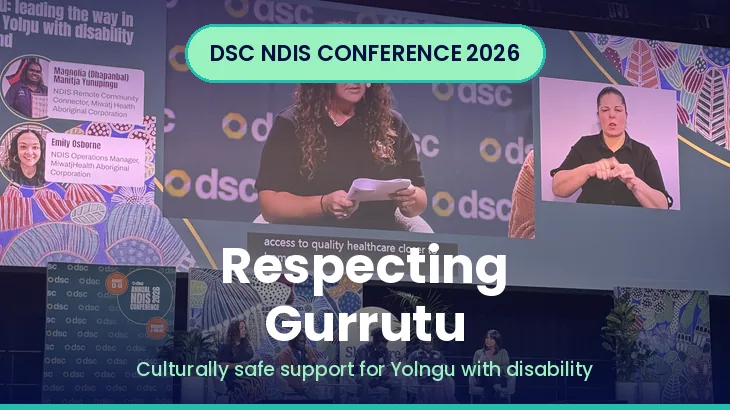
One of the most moving sessions of the day came from a team who had travelled a long way to be there. Miwatj Health Aboriginal Corporation, an Aboriginal Community Controlled Health Organisation serving Yolŋu communities across East Arnhem Land, shared how they design disability support that keeps culture, family and country at the centre. Hosted by Bridie Totham of Keogh Bay Consulting, the session featured Miwatj's NDIS Operations Manager Emily Osborne alongside three Remote Community Connectors, Julie-Anne Gondarra, Magnolia Yunupingu and Samuel Gondarra, who spoke in Yolŋu Matha with interpretation.
The central message was simple and challenging at once: culturally safe support is not an add-on, and following the rules alone does not create good outcomes.
Why country and kinship come first
For Yolŋu people, Emily explained, country is far more than where you live. It is connection to family, ancestors, language, identity, law and belonging, and remaining on country supports not just physical health but cultural, spiritual, emotional and social wellbeing. Western systems tend to frame wellbeing around an individual's needs and outcomes, but for many Yolŋu, wellbeing is inseparable from relationships, community and cultural responsibilities. Culture itself, speaking language, ceremony, sharing knowledge, time on country, is a protective factor, not just an activity.
Family and kinship networks often provide substantial support long before any formal service arrives. The role of an NDIS provider, the team argued, should be to strengthen those natural supports rather than replace them. That is why access to support on country matters so much: when people can be supported close to home, they do not have to choose between the help they need and the people, places and culture that make them strong.
The ROM framework
Miwatj's Yolŋu and non-Yolŋu staff developed an NDIS framework they call ROM, after the Yolŋu word for law. It guides all their work with Yolŋu who have disability, with a vision that people are strong, safe and supported. The Remote Community Connectors walked through its core concepts in language, including gurruṯu (kinship, and the relationships, respect and protocols that come with it), leading with a kind heart and caring for one another, making safe spaces for people who feel overwhelmed (including taking people out on country), community control, quality, and decision-making that respects a person's choices rather than making choices for them.
A recurring theme was that Yolŋu Matha has no word for disability, and most disability systems come from Western thinking. So the team's task was to meet Western compliance requirements while still working in a way that respects Yolŋu culture and relationships, connecting the two worlds instead of forcing people to choose between them.
The real-world tensions
The team was frank about how hard this is. Dignity of risk sits at the centre: many valued cultural activities, from spearfishing in crocodile country to cooking a catch on an open fire, are high-risk from a work-health-and-safety or food-handling perspective. Compliance systems built for metropolitan services do not fit remote realities. Worker screening and strict ID requirements are a barrier when some staff and board directors were never issued a birth certificate, or not one with the right name. Heavy administrative and reporting demands assume a level of digital access and literacy that many staff do not have.
Then there is market failure. In many remote communities there simply are not enough providers, so ACCHOs like Miwatj end up filling gaps beyond their scope, participant plans do not carry funding that matches the region's needs, and there is little or no provider choice. The team also named a hard truth: underserviced, high-pricing remote markets can attract unethical providers who lack the workforce or the community relationships to do the work safely. All of this plays out in one of the most socioeconomically disadvantaged, and largest, regions in the country.
What good practice looks like
Asked for practical guidance, Emily was generous with it. Cultural responsiveness starts at the very first interaction, not when a support worker arrives at someone's door. During intake, slow down: rather than rushing to goals, funding and a signed contract, take time to understand who the person is, their family, their languages, and who the important decision-makers in their life are.
On workforce, cultural responsiveness cannot rest solely on First Nations staff. Where possible, employ First Nations people and create genuine leadership pathways, and invest in local cultural mentors and advisors who understand the country, community and kinship where you work. Crucially, cultural capability should not be a one-off induction; it belongs in supervision, reflective practice and performance conversations, with staff regularly asked what they have learned and how they are adapting.
Service delivery has to be flexible. A participant may arrive with several family members, appointments may be rescheduled around cultural obligations, and decisions may be made collectively rather than individually. These are not barriers to work around but part of effective delivery. And cultural safety has to reach into governance: if First Nations voices are not shaping your services, it is hard to claim those services are culturally safe. The team urged providers to measure cultural safety with the same seriousness as compliance and quality, and never to operate in isolation, but to partner with the Aboriginal Community Controlled Organisations and trusted networks that already exist, because building trust from scratch takes years.
What this means for providers
If you support First Nations participants, this session is a blueprint. Start relationships slowly, build cultural capability into everyday supervision rather than a single induction, make room for family and collective decision-making, and put First Nations people into your governance, not just your frontline. Above all, partner with local ACCHOs rather than competing with them.
What this means for support coordinators, LACs and intermediaries
Watch for the funding and market gaps the team described: plans that do not match a region's real needs, and thin or unsafe provider markets. Connecting participants to trusted community-controlled organisations, and advocating for plans that reflect remote realities, is some of the most valuable work you can do here.
What this means for participants and families
The message from Miwatj was that you should not have to leave country, or leave culture at the door, to get the support you need. Good providers slow down, learn who your family and decision-makers are, and build support around your life, not the other way around.
The closing reflection captured it: being culturally responsive is not about having all the answers. It is about listening, learning and being willing to adapt, so that people do not have to navigate between two worlds.
Meet the speakers
Emily Osborne, NDIS Operations Manager, Miwatj Health Emily leads NDIS operations at Miwatj Health and has close to a decade of experience with the scheme, working alongside Yolŋu communities across East Arnhem Land.
Julie-Anne Gondarra, Magnolia Yunupingu and Samuel Gondarra, Remote Community Connectors, Miwatj Health Remote Community Connectors from communities in North East Arnhem Land who support Yolŋu participants and families to navigate the NDIS, bringing deep knowledge of language, kinship and community. Magnolia is also a renowned singer and songwriter.
Bridie Totham, Keogh Bay Consulting (host) Bridie is a consultant with Keogh Bay, a First Nations and non-Indigenous collective working in the disability sector, and has worked with Miwatj Health for many years.
Further reading
Miwatj Health NDIS services. Overview of Miwatj's disability supports and Remote Community Connector program across East Arnhem Land: https://www.miwatj.com.au/our-services/ndis/
Going North: The Gunga Spiral (ARDS). A free workbook from Aboriginal Resources and Development Services, developed with Yolŋu workers and families and funded by the NDIS Quality and Safeguards Commission. It gives non-Indigenous providers a relationship-first, five-step framework for working alongside Yolŋu participants, built around the image of the gunga (pandanus) growing in a spiral, and includes a culturally safe pathway for raising a concern or complaint. It is meant to be used together with participants over several sessions, alongside cross-cultural training and a Yolŋu cultural advisor. https://ards.com.au/
A note on this series: this is Clickability's plain-English summary of a session at the DSC Annual NDIS Conference 2026, based on what was said on the day (13 August 2026). It reflects our interpretation and is not the official position of DSC, the speakers or the NDIA, and it is not NDIS or employment advice.
Clickability editorial update: September 2026
For providers: turn the reflection into an intake check
Review the first contact your service makes. Can a person explain their language, communication preferences and who they want involved before being asked to sign documents? Decide how you will arrange an appropriate conversation and whose local knowledge you need.
Miwatj describes its community-controlled approach and Remote Community Connectors’ cultural brokerage on its NDIS services page. Use local, community-controlled knowledge when planning your own practice. The article’s Yolŋu-specific concepts should not be treated as a checklist that applies unchanged to every community.
What coordinators can clarify before making a referral
Ask the participant how they want the referral conversation to happen, which people they want involved and what the provider needs to understand first. Check the practical service area and availability directly. A culturally respectful introduction cannot resolve a provider shortage on its own.
If you are comparing support coordination services, ask how the coordinator works with local organisations and communication supports. Record the participant’s choices so later referrals do not repeatedly restart the conversation.
Questions readers ask
Is this a new interview with Miwatj’s team?
No. The original article is Clickability’s account of the August 2026 conference session. The editorial additions are separate practical reflections.
Where can I read about Miwatj’s services directly?
Miwatj’s own NDIS page describes its services, Remote Community Connectors and resources for working alongside Yolŋu participants. Official guidance
Find coordination that starts with your preferences
Tell Clickability about the support coordination you need, including location and communication preferences. Discuss cultural responsiveness and local relationships directly with any provider you consider.