NDIS functional capacity assessments: the advisory group’s role
Inside the Technical Advisory Group deciding how NDIS access will be assessed
By Clickability · Originally published 18 August 2026
Original article and dated context
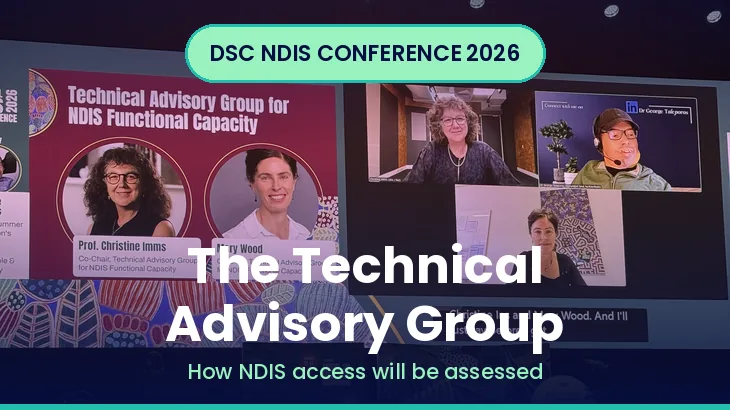
Few reforms will matter more to who gets into the NDIS than the way "substantially reduced functional capacity" is assessed. So this session brought the two co-chairs of the government's new Technical Advisory Group, Professor Christine Imms and Mary Wood, into conversation with Dr George Taleporos to explain what the group is, and is not, setting out to do.
Two very different chairs, by design
The pairing is deliberate. Professor Christine Imms comes from an occupational therapy background with clinical, academic and research experience, mostly in childhood-onset disability. She holds the Apex Australia Foundation Chair of Neurodevelopment and Disability at the University of Melbourne, directs a child and youth disability research hub called Healthy Trajectories, and recently led the review of best practice in early childhood intervention and the development of a new national framework for it. She brings expertise in child development, functional assessment, measurement and allied health.
Mary Wood describes herself as a generalist and a federal public servant. Her contribution is an understanding of government decision-making and the expectations ministers set when they established the group. Between them, they cover the clinical and technical on one side and the machinery of government on the other.
[Clickability update, September 2026: The Bill has since passed. The group provides technical advice on future access assessments; it does not decide an individual’s eligibility or plan budget. Read the group’s published role and the legislation history.]
Why the group exists
The Technical Advisory Group, or TAG, was formed because the government needs independent, evidence-based advice on how to apply "substantially reduced functional capacity," which is the key access test in the new legislation. As Mary explained, this traces back to the NDIS review's finding that the current way people do (or don't) get into the scheme is inconsistent and unfair, and doesn't reliably direct support to those who need it most. The stated plan is that from 1 January 2028, subject to the bill passing and commitments playing out, people applying through the disability pathway would be assessed or reassessed on their functional capacity using a standard, evidence-based process.
Importantly, the TAG advises; it does not decide. It provides advice to government on the best evidence-based frameworks for these assessments, and the detail of how that is then done will be defined in rules and guidelines by the NDIA once government has the group's views. Its terms of reference are published.
Who's in the room
Christine was candid that this is a big responsibility, and that getting it right matters enormously. What tempers the anxiety, she said, is the breadth of expertise around the table. The group deliberately spans the life course, from childhood to adulthood, and a range of disability types including degenerative conditions and psychiatric and psychosocial disability. It includes lived experience of disability, alongside deep expertise in statistics, assessment design, administrative law and human rights. It also brings in representatives from state and territory governments, the NDIA, and the Department of Health, Disability and Ageing, so the group can gather what it needs to form robust, useful advice.
She was refreshingly honest that members do not always agree on the right approach, and framed that as a strength rather than a problem: bringing genuinely diverse perspectives to bear is, she said, the only way to reach a good answer. At the time of the session the group had held two formal meetings, and the early work was about getting clear on the task and reviewing the material before shaping the deliverables government has asked for.
[Clickability update, September 2026: This paragraph describes the consultation expected at the conference date. Check the department’s current consultation information for the actual scope and closing date rather than assuming an August invitation is still open. Use the group’s consultation links.]
How people can have a say
For a reform this consequential, engagement matters, and there are several routes. A formal public consultation was due to open by the end of August through the department's consultation hub, open to anyone who wants to make a submission. Alongside that, there is structured engagement with disability representative organisations, and more informal engagement as TAG members draw on their own networks of experts and people with lived experience.
What this means for participants and prospective participants
This is the machinery that will shape who is found eligible for the NDIS in future. If you are applying, or already on the scheme and could be reassessed, the assessment of functional capacity is the thing to watch, with the stated start point of 1 January 2028. The most concrete action available now is to engage with the public consultation when it opens, so the framework is shaped by real experience and not just technical design.
What this means for providers and allied health professionals
Allied health professionals, occupational therapists especially, have an obvious stake here, since functional assessment is their domain and they may be involved in gathering the evidence these decisions rest on. Watching the TAG's work, and contributing through consultation and professional bodies, is worthwhile. Providers should note that access decisions upstream will shape who is in the scheme, and plan for a future where a standardised functional capacity process sits at the front door.
What this means for support coordinators, LACs and intermediaries
You are often the people who help participants understand and navigate access and reassessment. Following how "substantially reduced functional capacity" is operationalised, and helping participants engage with the consultation, is a practical way to support the people you work with through a significant change.
The measured message from the co-chairs was one of careful process over quick answers: an expert, deliberately diverse group, doing technical work in public view, with consultation built in, on a reform whose fairness will depend on getting the detail right.
Meet the speakers
Prof. Christine Imms, Co-Chair, Technical Advisory GroupLinkedIn Christine holds the Apex Australia Foundation Chair of Neurodevelopment and Disability at the University of Melbourne and directs the Healthy Trajectories research hub. An occupational therapist by background, she led the recent national review and framework for early childhood intervention.
Mary Wood, Co-Chair, Technical Advisory Group Mary is a senior federal public servant and generalist who brings expertise in government decision-making and policy process to the co-chair role.
Dr George Taleporos (host)LinkedIn George is a prominent disability rights advocate and host of the "NDIS and Science with Dr George" podcast, and a long-standing friend of DSC.
A note on this series: this is Clickability's plain-English summary of a session at the DSC Annual NDIS Conference 2026, based on what was said on the day (13 August 2026). It reflects our interpretation and is not the official position of DSC, the speakers or the NDIA, and it is not NDIS or employment advice.
Clickability editorial update: September 2026
How participants can make feedback about access assessments useful
Describe the feature of an assessment that matters to your experience: fluctuating needs, communication, access to evidence or the effect of a particular activity. Explain what would help the assessment capture it accurately.
Check the live consultation’s scope and deadline before submitting. Keep a policy submission separate from an individual access or plan issue; use the relevant agency process for that decision. The advisory group cannot change your plan.
How practitioners can contribute relevant evidence to design
Separate the question of functional capacity for access from the person’s support needs and environment for planning. Explain what a proposed tool measures, its limitations and the adjustments needed across disability types.
Contribute through the published engagement route and your professional channels. Do not present an unfinished assessment framework as a compulsory new report that every current client must buy. Check the advisory scope.
Questions readers ask
Does the Technical Advisory Group decide my eligibility?
No. It gives technical advice to government on assessment approaches; it is not the individual decision-maker. Official guidance
Is this the same process as new framework budgeting?
No. Access-assessment design and support-needs assessment for the plan budget have different purposes. Official guidance
Find providers with experience relevant to your assessment needs
Describe the service and access needs you want help with through Clickability. Compare profiles and reviews, then ask about relevant qualifications and report scope.