NDIS legislation changes: reviewing the 2026 conference summary
NDIS reform in motion: what changed in 2025-26, and what's still up in the air
By Clickability · Originally published 18 August 2026
Original article and dated context
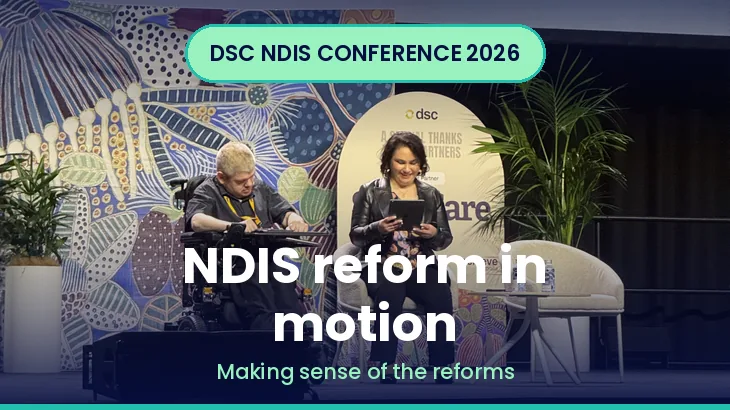
DSC's Annual NDIS Conference opened in Brisbane on 13 August 2026, and the tone was set before a single slide appeared. The Welcome to Country was delivered on behalf of Uncle Shannon Ruska, who was unwell, by a family member who spoke to his mob's connection to Country and shared the story of how the land, its mountains and its waterways were formed. DSC Managing Director Evie Naufal and comedian and disability rights advocate Madeleine Stewart then opened the two days with a simple challenge. After years of the NDIS, in Madeleine's words, "really been NDIS-ing", the sector has spent a decade focused on what it wants government to do differently. This conference, they said, would try to shift some of that attention back to what providers, participants and the people around them can actually control.
Then came the download. Sara Gingold and Todd Winther took on the job of catching a very informed room up on everything moving in the scheme, in about 20 minutes. Here is the plain-English version.
Pricing: promised early, delivered late
The pricing arrangements and price limits document (the pair's affectionate "the paper") was promised earlier this year, but landed on 22 June, for rules that had to be operating by 1 July. This year the NDIA published only a pricing schedule: the price limits, without the arrangements and rules that usually sit alongside them. Disability support worker prices rose in line with the recent SCHADS award increase, and some supports such as psychology and specialist behaviour support also went up. Support coordination and plan management price limits stayed frozen, as they have for several years, and some allied health prices were held or cut. Short-term accommodation funding is being redesigned. The likely reason the full document is missing is that the government is waiting on legislation that would let the Minister set price limits directly, so another update may not be far away.
[Clickability update, September 2026: The amended Bill passed Parliament on 19 August and received Royal Assent on 20 August. Check the enacted text and commencement table rather than applying the conference’s draft summary as current law. Read the Act.]
The bill that changes the settings
The Securing the NDIS for Future Generations bill was the centre of gravity. A few of the changes that matter most:
Planning. The Minister would be able to make a "support determination" to reduce funding across all plans, or for a particular group, by a set percentage. The government has already flagged cutting social and community participation funding by around 50% and improved daily living by around 10%. Reassessments would become harder to get, unspent funding would no longer roll over at the end of a plan, and the Minister could set maximums for particular supports.
Eligibility. The bar to get in would rise, with stricter rules about when a disability counts as permanent and a requirement to have tried all appropriate treatments first. It also lays the groundwork for functional capacity assessments for everyone applying and everyone already on the scheme. All of this sits inside a stated government goal of reducing the number of people on the scheme.
Provider market and compliance. More power to crack down on fraud and non-compliance.
At the time of the session, the Senate inquiry was days from reporting, after an eight-week extension negotiated with the Greens, with talk of a deal with the Coalition but nothing confirmed.
[Clickability update, September 2026: Current guidance places new framework planning for participants aged 18 and over from April 2027 to December 2030. This replaces the earlier over-16 description. Budget assessment and future access assessment remain distinct. See current planning guidance.]
Two different tests: eligibility versus budgets
One of the clearest explanations of the day was the difference between two assessments people will hear a lot about. A functional capacity assessment measures level of impairment and is intended to decide who is eligible. A support needs assessment measures what support a person needs to live their life, and is intended to build the budget. New "framework plans" will be built from a support needs assessment, rather than the old line-by-line approach. For people aged 16 and over, the I-CAN tool is slated for the support needs assessment. New framework plans are expected to start rolling out around April, though both speakers were openly sceptical about whether that date holds.
Foundational supports and Thriving Kids
Foundational supports are the supports meant for people outside the NDIS, and most of the detail is still missing. What is known is Thriving Kids, rolling out from October for children aged 0 to 8 with mild to moderate autism or developmental delay. It will largely be delivered by state and territory governments, which made Queensland Disability Minister Amanda Camm's later session especially relevant. At the time of the talk, Queensland was the only state yet to sign an agreement with the federal government on how Thriving Kids will work.
[Clickability update, September 2026: SIL and defined digital platforms have registration requirements with transitional arrangements. The requirement starting in July does not mean every existing provider had already completed registration. Support-coordination mandatory registration is currently paused. Read the Commission’s current guidance.]
Registration, intermediaries and safeguarding
A few faster-moving items:
Mandatory registration became required for supported independent living and platform providers from 1 July, alongside new practice standards. The government intends to extend registration to all high-risk supports, including personal care, daily living and supports in closed settings, by December 2030, with a basic enrolment and identification step for most providers by December 2027.
Intermediaries remain unsettled. The 2023 NDIS Review recommended replacing support coordination with a navigator function, but the government has not formally responded, leaving a vacuum. Minister Mark Butler has signalled the government may directly commission support coordination, so participants would access it through commissioned providers rather than their own plan budgets. Plan management is heading towards a panel-style arrangement, with a formal agreement required with the NDIA from 1 October 2027.
Integrity and safeguarding, which the speakers called the "poor stepchild" of the reforms, brings new penalties and criminal offences and gives the Commission power to issue orders against promotion, aimed at the "NDIS-funded holiday" style ads. New practice standards have been consulted on, without a release date.
[Clickability update, September 2026: The 10% January 2027 change was a pricing recommendation. Do not treat it as an implemented rate or alter invoices without a formal effective document. Check the pricing index.]
Differentiated pricing
Finally, differentiated pricing: the long-discussed idea that providers meeting certain benchmarks could claim at higher rates. From January 2027, unregistered providers delivering social and community participation are set to face a 10% reduction, and a quality support pilot is exploring the real cost of high-quality support coordination, therapy and SIL, which could feed into a differentiated model.
[Clickability update, September 2026: The rollover statement below concerns plan boundaries. Unused funds within a funding period can roll into a later period of the same plan; they are not a new allocation at the end of a plan. See funding guidance. The conference’s access and Thriving Kids predictions do not decide an individual’s eligibility.]
What this means for participants
Eligibility is getting harder, and new assessments are coming, so if you are already on the scheme it is worth understanding how a functional capacity assessment (eligibility) and a support needs assessment (budget) differ. Two funding areas are flagged for cuts, social and community participation and improved daily living, and unspent funding will no longer roll over, so how you use your plan matters more than ever. If you have a young child with autism or developmental delay, Thriving Kids from October may become the pathway rather than the NDIS. The practical move now is to keep your evidence current and get support to understand any assessment you are asked to do.
What this means for providers
Two levers will separate the ready from the exposed: registration and pricing. Map your services against the registration timeline (SIL and platforms already in, all high-risk supports by December 2030, enrolment and ID by December 2027) and treat differentiated pricing as a reason to start documenting the quality of your supports today. With support coordination and plan management prices frozen, and a possible shift to commissioned support coordination and a plan-manager panel, any business built on intermediary revenue needs a hard look at its assumptions.
What this means for support coordinators, LACs and intermediaries
This is the most uncertain corner of the scheme. The review's navigator recommendation is still unanswered, and the signal that support coordination could be directly commissioned would change how the service is funded, moving it off participant budgets. Plan managers face a panel or approved-provider arrangement, with a formal NDIA agreement from October 2027. Until the government formally responds to the review, the sensible approach is to plan for more than one scenario.
What this means for families and early-childhood services
Thriving Kids is the headline: children aged 0 to 8 with mild to moderate autism or developmental delay, from October, delivered mostly by the states. Queensland families and early-childhood providers should watch the state and federal agreement closely, since Queensland was the last state yet to sign at the time of the talk.
The session closed on a line that summed up the whole conference mood: in the NDIS, 24 hours is equivalent to 24 years. With the Senate inquiry due to report the very next day, even this summary came with a shelf life. We will keep tracking what actually lands.
Meet the speakers
Sara Gingold, Editor in Chief, DSCLinkedInSara leads DSC's Resource Hub and is widely read as the writing voice of the organisation, known for turning dense NDIS policy into clear, plain-English analysis. She has a background in international development.
Todd Winther, Subject Matter Specialist, DSCLinkedIn A political scientist by training, Todd has taught political leadership, party politics and disability policy at the University of Queensland and the University of the Sunshine Coast, and previously worked at Youngcare. He brings lived experience of disability to his work, with a particular focus on home and living and the NDIS in its public-policy context.
Evie Naufal, Managing Director, DSC (co-host)LinkedIn: Evie has been part of DSC since 2014 and now leads it as Managing Director. With a Masters in Sustainable Development from HEC Paris and earlier human-centred design work at Procter & Gamble, she has been central to DSC's content-led approach and is well known in the sector for her work on support coordination.
Madeleine Stewart, comedian and disability rights advocate (co-host) Website: https://www.madeleinestewart.com Madeleine is an award-winning stand-up comedian, writer and producer, and the creator of Crips & Creeps, Sydney's first accessible comedy club. Her main channels are her website, Facebook and Instagram. A LinkedIn profile was not confirmed.
Welcome to Country: Uncle Shannon Ruska, Tribal Experiences The Welcome to Country was delivered on behalf of Uncle Shannon Ruska, Storyteller, Elder and Managing Director of Tribal Experiences, who was unwell on the day.
A note on this series: this is Clickability's plain-English summary of a session at the DSC Annual NDIS Conference 2026, based on what was said on the day (13 August 2026). It reflects our interpretation and is not the official position of DSC, the speakers or the NDIA, and it is not NDIS or employment advice.
Clickability editorial update: September 2026
How providers can turn the conference overview into verified actions
Take each measure relevant to your service and check its enacted wording, commencement date and any transition rule. Record the source alongside the action owner. Keep registration, pricing and commissioning in separate parts of the plan.
Use recommendations to consider scenarios, but change billing only when an applicable effective document and agreement support it. Tell participants what actually changes for their service rather than repeating a conference forecast.
What participants can ask when a provider refers to reform
Ask which official measure the provider means, when it applies and how it affects your actual plan or agreement. A general change in law does not explain a particular invoice or cancelled service.
Keep notices and a record of the support you receive. If someone proposes a change, ask for its details and who can review the decision.
Questions readers ask
Was the Bill still pending at the time of this session?
Yes. The session was on 13 August; Parliament passed the amended Bill on 19 August and Royal Assent followed on 20 August. Official guidance
Is a conference pricing recommendation an effective billing rate?
No. Check the formal effective pricing documents and applicable conditions. Official guidance
Compare providers and ask about the support they deliver
Use Clickability to describe your service requirements. Compare profiles and reviews, then ask providers to explain current costs and relevant arrangements.