Thriving Kids: family support and the early-childhood model
Thriving Kids: getting early childhood support back to basics
By Clickability · Originally published 24 August 2026
Original article and dated context
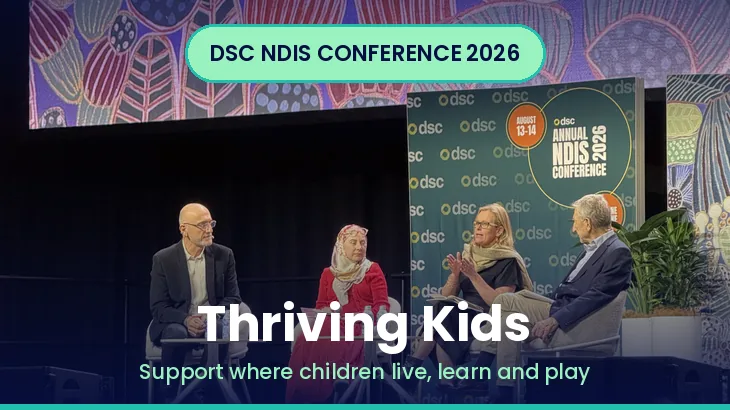
The conference closed on one of its most hopeful notes. Introducing the panel, Roland Naufal did not mince words: two of the biggest missteps of the NDIS have been psychosocial disability and kids, with early childhood support rolled out in a way that ignored decades of best practice. Thriving Kids, he argued, finally has the right foundations to correct that, and he had three of the people who helped build them to explain it: Professor Frank Oberklaid, who co-chaired the Thriving Kids Advisory Group, Jill Hellemans of All Aboard Inclusion, and Sylvana Mahmic of Plumtree Services.
[Clickability update, September 2026: The agreement discussion below reflects the conference date. Check current state and Commonwealth information for local delivery arrangements; this review does not independently confirm a Queensland agreement or local service opening.]
First, the Queensland context
Ahead of the panel, a short video from Queensland Disability Minister Amanda Camm noted a $5.9 million state investment in disability advocacy services so people with lived experience are heard through the reforms. She voiced support for holding poor providers to account, but flagged concern about the pace of change and what looks like a cost shift to state governments, committing to work on viability, quality and safeguarding. Notably, Queensland remains the only state or territory yet to sign the national Thriving Kids agreement, which made the session especially live.
What problem is Thriving Kids solving?
Frank Oberklaid began with something he called uncontested: best-practice child development. Pick up concerns as early as possible, assess appropriately, intervene early (the research is unambiguous that earlier intervention means better outcomes), and put parents at the centre. The NDIS, he argued, departed from all of that. Because you needed a diagnosis to get any treatment, community, state and place-based services atrophied as the NDIS became "the only game in town." The focus shifted to what was wrong with a child rather than their strengths, parents were sidelined, and access and equity suffered through long waits and inequity. A good outcome became how much money you were granted, after which families still had to go hunting for therapists, creating long delays between a concern being raised and real intervention beginning.
[Clickability update, September 2026: This is the panel’s interpretation of best practice. Earlier help and a family-centred approach do not guarantee the same outcomes for every child or establish that any particular program is effective. Ask about support suited to the child.]
[Clickability update, September 2026: This is the speaker’s criticism of system experience, not a complete statement of eligibility. Early connections already provide pathways for children under 6 without a diagnosis. Read current early-childhood help options.]
The conceptual model came out of a thorough process: an advisory group he co-chaired (three all-day meetings plus six half-day deep dives and a literature review), running alongside a parliamentary inquiry chaired by Monique Ryan and Mike Freelander that took around 400 submissions. The result returns to best practice. It removes the need for a diagnosis to get support, changes the language from diagnosis to support, and puts parents at the centre. Concerns can be picked up by anyone, wherever children live, learn and play, at home, in childcare, preschool or school, with intervention starting as soon as a concern is raised (any diagnosis can be pursued separately). Instead of asking what is wrong, the model asks: what does this child, in this family, need over the next six months to thrive? The aim is to rebuild capability in children and parents and to strengthen the systems around them, identification, clinical practice and referral pathways.
He was pointed about how the money distorted practice: it flowed to professionals to make diagnoses rather than to families and services close to home, so a paediatrician like him increasingly received one-line referrals to "confirm the diagnosis of autism spectrum disorder" rather than to assess a child and recommend support, because a diagnosis was the only route to help.
What families actually experience
Jill Hellemans made it concrete, from 25 years of practice. A family senses something, then enters the medical model: a GP, a wait for a paediatrician (long in rural and regional areas), disclosing their life story and completing a parent impact statement about the hardest things, very early in their journey. Once they have a plan, they navigate early intervention largely alone, on social media, on more waiting lists, booking OT, speech and psychology that all happen in isolation, then acting as the case manager who carries information between therapists and into their child's early-childhood setting. By the time they have found therapists and juggled the appointments, notes and driving, parents are exhausted, at exactly the point we want them embedding therapy into everyday life.
She named a worrying shift toward clinic-based sessions (partly driven by travel-cost changes), where children practise isolated skills in sterile rooms while parents are sent to the waiting room for being "distracting." That, she said, has lost the capacity-building that matters most. Thriving Kids flips it: go to where children are, home, preschool, the playground, even the supermarket, and build the capacity of the people in that setting, the whole family (grandparents and aunties included) and the educators. Imagine, she said, an educator noticing a need and putting supports in place, then telling a family "here's what I've already done" rather than pushing them toward a diagnosis to unlock a plan, bringing hope to the table instead of deficits. The clinching research point: for most children it is not the number or intensity of therapy sessions that makes the difference, it is the capacity of the family.
A bridge to a good life
Sylvana Mahmic brought the family and systems lens, and a story: her own mother took 18 years to process that her grandson had a disability, because while the eat, drink, walk, talk is comparatively easy, learning about your child and how to build a good life for them is the hard part the system has never given families space for. Her "bridge model" pictures the destination as a good life for child and family, reached via three laneways: parent-peer support and peer-led organisations, community inclusion, and specialist supports if and when needed. Families move between them over time. Under the NDIS, the professional-services laneway became "super-paved" because that is where the funding sat, while the peer-support and inclusion laneways stayed "dusty, dirty and bumpy." Thriving Kids' opportunity is to build those other two laneways out, with any specialist support delivered in line with the 2025 National Best Practice Framework for Early Childhood Intervention: family-centred, participation-focused, relationship-based and culturally responsive.
She and Frank made a strong case for trained parent-peer workers (as in mental health): research shows parents supporting parents gain information they would never otherwise get, feel more in control, and, crucially, no longer feel alone. Professionals and parent-peer support, Sylvana said, are "two wings of a bird", and a bird with one wing will not fly.
[Clickability update, September 2026: These are the panel’s expectations for a service model, not a guarantee every family can access each service at launch. Check local pathways and keep using current support arrangements while individual changes are clarified. Read the staged national rollout.]
What this means for families
This is the most hopeful development for families of young children in years: no diagnosis required to get help, support that comes to your home, preschool or school, and your own capability treated as the thing that matters most. Expect more peer support and community inclusion, and specialist help delivered in everyday settings. The panel was honest that it must be properly funded to work, and that peer support cannot be a substitute for genuine specialist need.
What this means for providers and allied health
The shift is from a private, session-based, clinic model toward capacity-building in natural settings and a more commissioned system. Oberklaid acknowledged real transition challenges for therapists who went private, but noted therapist shortages mean the work remains, with changing work arrangements. Providers who can embed alongside educators and families, and who work to the National Best Practice Framework, are well placed.
What this means for early-childhood educators and schools
Educators become central. Jill's model embeds therapists and educators together on the floor across the whole day rather than pulling children out, and she has seen educators apply those strategies to other children too, lifting the whole setting. Building educator capacity, she argued, is where the biggest gains lie.
What this means for support coordinators and intermediaries
As families move from an NDIS-only pathway to a broader ecosystem, helping them find local providers who know their community and understand the framework, and connecting them to peer support, becomes valuable navigation work.
Q&A
How will rural and remote areas be served? Oberklaid said this is a long-standing challenge; fly-in-fly-out does not work well and telehealth has been underused. The best answer is a hybrid: an initial face-to-face visit to build relationships, then online support, with funding designed to support that. Stigma in small communities also needs addressing.
How does focusing on schools help all children? Hellemans described partnering with a community preschool where 30% of children need support; embedding therapists and educators together (not a pull-out model) across the whole day means children without a diagnosis get help too, and educators carry the strategies to other children. Building educator capacity, she said, is the key.
What about parent and carer burnout? Mahmic said the current system drives burnout because it isn't built on hope, empowerment and wellbeing; peer workers help families do more with what they already have, but the system must still be properly funded so peer support isn't used to paper over missing services.
What about parents in the child protection system or not coping? Hellemans said the current system has most failed those in greatest need, single parents, families with several children with disability, those in child protection, and that culturally appropriate, individualised, family-centred approaches are essential.
Will Thriving Kids be standardised across Australia? No. Oberklaid said the Commonwealth framework is shared and states sign up to it, but specific responses will differ by state and community, which is appropriate; it is not one-size-fits-all.
Meet the speakers
Prof. Frank Oberklaid, co-chair, Thriving Kids Advisory Group Frank is a professor of paediatrics at the University of Melbourne and co-group leader of policy and equity at the Murdoch Children's Research Institute, and co-chaired the advisory group that conceptualised the Thriving Kids model.
Jill Hellemans, Founder and Clinical Director, All Aboard Inclusion Jill is a behaviour analyst and special educator whose program embeds early intervention directly within mainstream early-childhood settings, building educator capacity.
Sylvana Mahmic, CEO, Plumtree Services Sylvana leads Plumtree Services, known for family-centred early-childhood practice, and brings the perspective of a parent of an adult son with disability and a researcher into how systems shape families' choices.
Roland Naufal, Director, DSC (host) Roland is a Director of DSC with decades in the sector.
Read the full 2027 NDIS changes summary from the reforms reshaping the NDIS to who's expected to stay or go and the crackdown on unscrupulous providers, we've pulled every hot topic and its likely outcome into one quick overview, then gone deeper on each with its own explainer written for both providers and participants, Q&A included. Get the lot in the DSC NDIS Conference 2026 wrap-up.
A note on this series: this is Clickability's plain-English summary of a session at the DSC Annual NDIS Conference 2026, held on 14 August 2026. It reflects our interpretation and is not the official position of DSC, the speakers, their organisations, the Queensland Government or the NDIA, and it is not clinical or NDIS advice.
Clickability editorial update: September 2026
How families can ask for support that fits everyday life
Identify the routine where your child needs support and the help you want as a family. Ask whether a service can work with you and the child’s educators, how it includes the child’s preferences and how it respects your communication and culture.
Check the actual local referral route, availability, fees and any connection with your existing plan. Peer support can be valuable, but it should not be treated as a replacement for a specialist service the child needs.
How early-childhood providers can work alongside families
Agree practical priorities with the child and family and identify what can happen in everyday settings. Clarify who will work with educators, how consent and information sharing will operate and how the family can raise a concern.
Check the actual commissioning or referral requirements in the relevant jurisdiction. A shared national model does not establish an identical contract, service mix or access route in every community.
Questions readers ask
Does an October start mean all local services are available immediately?
No. Supports will expand over time. Check the relevant local access and delivery arrangements. Official guidance
Do all children need a diagnosis before asking for early help?
No. Current early-childhood guidance includes early connections for children under 6 without a diagnosis. Official guidance
Find providers to discuss your child’s everyday support needs
Tell Clickability the support and location you need. Compare reviewed and rated profiles and ask about family-centred practice and current availability.