Autism and employment: a personal journey into work
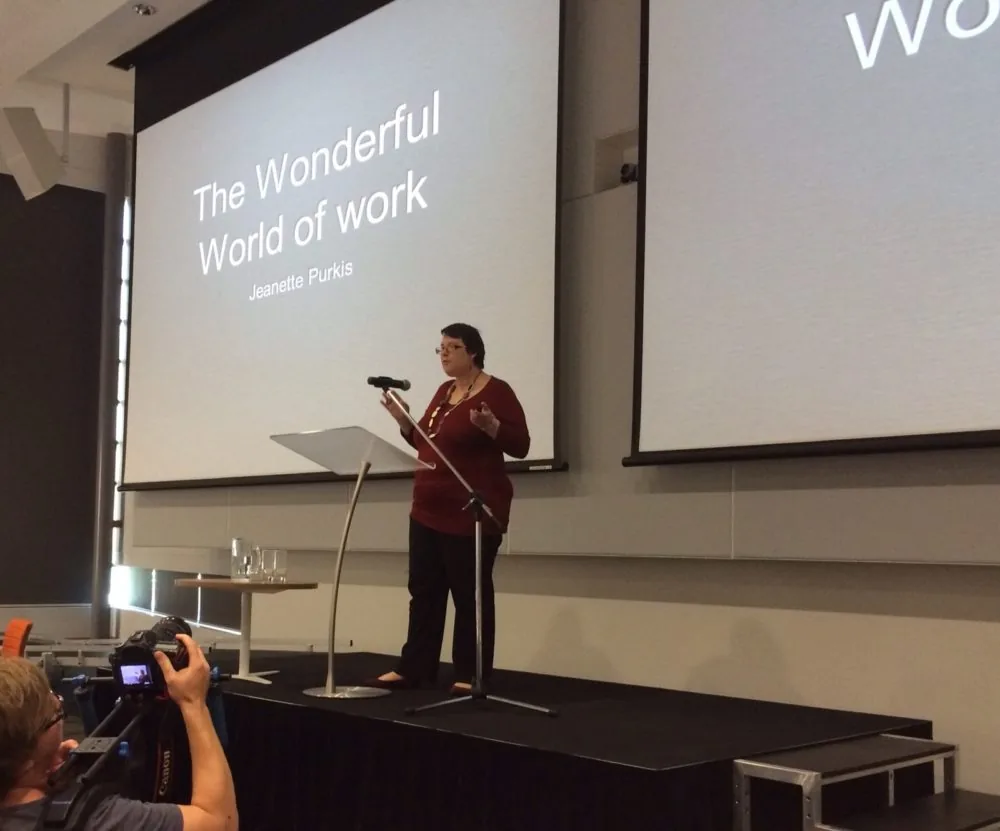
My Wonderful World of Work
By Jeanette Purkis · Originally published 11 May 2016
Original article
When I was a child, my dad had a market garden. Times were tough and he worked long days to keep us all fed and clothed. He even had lights in the greenhouses so that he could work after dark. Some days I would only see him at breakfast and dinner. The main lesson I took from this was that you need to work hard to survive.
I left home at 17. In order to fund my independent living, I got a job. This was in 1992, in the middle of a major recession. I went to a lot of job interviews and ended up getting a job in a fast food restaurant. That ingrained work ethic from my childhood meant that I was highly proficient at a job I actually hated. I was promoted to junior manager.
Sadly, life got in the way of my trajectory to whatever lofty place I would have gone to in the burger business hierarchy. I was unaware of this for a few more years, but I am Autistic. This meant that twenty-something me was way too trusting and was constant prey to abusers. Combined with bullying through high school and undiagnosed depression and anxiety, I became negatively-focussed and actively sought out horrible and self-defeating experiences.
I quit my fast food job after the new store manager sexually harassed me. I then lost five years of my life to drugs, crime and self-destruction. It seemed that there was not a lot of hope for me. When I was 21, I was also diagnosed with schizophrenia.
When I was 26 I underwent a very marked change in how I saw life. I decided I wanted to be ‘ordinary’. What that meant was that I wanted a university education, a professional job, a mortgage and a suit. When this intriguing notion first came to me I was living in residential care for people with severe mental illness and had been released from prison less than twelve months previously. My wish to be ordinary was – at that time – completely preposterous. Had I told anyone my intentions I imagine they would have laughed. I enrolled in university and made sure I got as many high distinctions as I could.
Halfway through my first year in university I decided to get a job. This turned out to be a Big Mistake. I was anxious and a perfectionist so in my mind the level of responsibility in my dishwashing job in a small restaurant was akin to flying a passenger jet or being a brain surgeon. I got so anxious that it turned into some kind of psychosis and I was lucky to get away with my life. Despite this setback, I didn’t give up on my dream of professional employment. I just thought I needed to wait for a while and build my strength before trying employment again.
Over the next six years I set myself a number of incremental challenges around employment in order to build my resilience, confidence and strength to work. I started out volunteering in a gallery. I then had a small business making videos for my fellow students at art school. Somewhere in there I met Autistic author Donna Williams, who became my Autism world and literary mentor. In four weeks I wrote an autobiography, which was published. The book changed my life and gave me a huge boost in confidence.
Three months after the book came out, I applied for two professional jobs in the public service. I was shortlisted for one and successful in the other. I became probably the most unlikely Government official in the country with my dubious past, various brain-related difficulties and fifteen continuous years of receiving welfare benefits. I loved the public service from my first day. I am still working in the department over nine years later. My professional job changed my life in many ways. Employment for me has been the key to independence and confidence.
Some tips around employment include:
If you have an ‘invisible’ disability, consider developing a plan around what, when and how much you will disclose to your employer about your disability.
Try to avoid chasing a ‘dream job’. ‘Dream jobs’ tend to not live up to people’s expectations or they never eventuate.
While there can be a lot of prejudice around disability and employment, don’t assume you will be disadvantaged due to disability or health conditions.
Skills are one of the keys to success in employment – both formal skills gained through education – and informal and ‘soft’ skills, such as attention to detail. Building skills is a great place to start preparing for employment.
Have someone to talk to, vent or work through issues around your job – although preferably not a colleague or manager.
Know what your rights are around employment and know where to go if those rights are violated.
Many people with similar health conditions to me really struggle with employment and it can be very hard. I am so fortunate to have the job I do now. I always think of my dad out on our property working until late in the evening to ensure our family could get by. I thank him for his example, which has played a large role in my determination to overcome my various challenges to find work.
Jeanette Purkis
Jeanette Purkis is an author, public speaker and Autism advocate who has a diagnosis of Asperger syndrome and atypical schizophrenia. Jeanette has worked full-time in the Australian Public Service since 2007 and has a Masters degree in Fine Arts. She is the author of Finding a Different Kind of Normal (an autobiography),The Wonderful World of Work (an activity book to help teens on the Autism spectrum prepare for joining the workforce) and The Guide to Good Mental Health on the Autism Spectrum. She hosts a radio show for the UK advocacy group Positively Autistic (Jeanette’s Autism Show) and has spoken at many conferences and events, including at TEDxCanberra 2013 and with Temple Grandin in 2015. Jeanette also facilitates a support group for women on the Autism spectrum in Canberra and is the Secretary and Public Officer on the Board of Autism Asperger ACT.
Clickability editorial update: October 2026
Build a work plan around your own priorities
Decide which parts of a job matter most to you: the tasks, hours, routine, environment or the support available. You can take useful ideas from the author’s experience without adopting their definition of being “ordinary” or their preferred career.
Think about what an employer needs to understand to support you and who you want involved in that conversation. JobAccess provides current information about workplace support. Ask about adjustments to the work itself rather than assuming you must overcome every barrier alone.
Support ambition without prescribing one measure of success
Ask the person what a successful work outcome would look like and what support they want from you. Full-time professional employment, as described here, is one possible outcome. Do not use a success story to judge someone whose goals, health or circumstances differ.
Work with employers on practical barriers and reasonable adjustments. Include the person in deciding what information is shared and how progress is reviewed. The support should make their chosen work more accessible, not reward them for hiding difficulties.
Questions readers ask
Is full-time professional employment the only successful outcome?
No. This is the author’s own goal and experience; people have different priorities.
Can workplace adjustments be part of employment support?
Yes. JobAccess explains reasonable adjustments and relevant responsibilities. Official guidance
Find support that works with your goals
Tell Clickability what assistance would help you pursue your priorities. Compare reviewed and rated providers and ask how they will support your choices.