By Kirrily Hayward · Originally published 27 July 2016
Original article
Vulnerability, according to the Oxford Dictionary, can be defined as, “The quality or state of being exposed to the possibility of being harmed, either physically or emotionally”. It’s a natural human state experienced at some time or another that teaches us resilience, in order to help us heal from emotional and physical wounds and grow as human beings. It is a natural trait that helps us analyse situations, breaking down those stubborn walls to open our hearts, minds and souls to find solutions with the support of trusted friends or confidants, to help us strengthen and reinforce inner spirit.
On the other hand, it can be viewed in a negative way. Certain groups within the community can be viewed as such, and assumptions are made, resulting in a ‘cotton wool’ experience for many people within the community. The consequences of this can often be lowered expectations from society, and the institutionalisation (not only in housing, but in many ways) of people with disabilities and mental illness.
The Social Model of Disability has many elements of which vulnerability plays a major part. Everyone has a right to participate and contribute to their society. In order to do so, we must have a few things. We must be able to explore and utilise their environments freely, without little or any obstacles. We should have housing and supports that suit our individual needs, hopes and goals. Lastly, we as humans need to feel safe and accepted within our global society.
There are many living with disability who don’t have these basic rights. There are still many instances of discrimination and exclusion for people with disability and mental illness. Whilst our global environment is becoming more physically accessible, many areas and buildings still aren’t. This makes accessing daily activity, education, and employment a lot harder than it should be. Many people with disabilities are living in poverty and don’t have access to a sufficient income needed to survive. There are few work opportunities, and people with disabilities are often forced to be self-employed. Access to education is a little easier in Australia, but for those who can’t afford it, it can often be a challenge.
Is the concept of vulnerability innate, learned, or environmental? Or a combination of the three? In my opinion, it can be a mix of all three, given individual circumstance.
It can be innate, dependent upon the natural resilience necessary in difficult situations. Of course, this can change at any given moment according to the given circumstance, and is often unpredictable. Innate vulnerability can also be present at times of mental distress, naturally lowering one’s tolerance to internal and external stress in their environment. Vulnerability can also be a learned behaviour. If a fairly resilient individual is placed within an environment and structure that they are not used to, they may feel helpless, like there is no way out. I, at one stage, felt exactly like this myself. With help people can often find a way out of this learned vulnerability in order to grow, and better themselves as human beings.
Vulnerability has played a part in my life on many occasions, helping me heal from personal demons (particularly in the last 3 years) and achieve greater acceptance of self. All while recovering from physical illness.
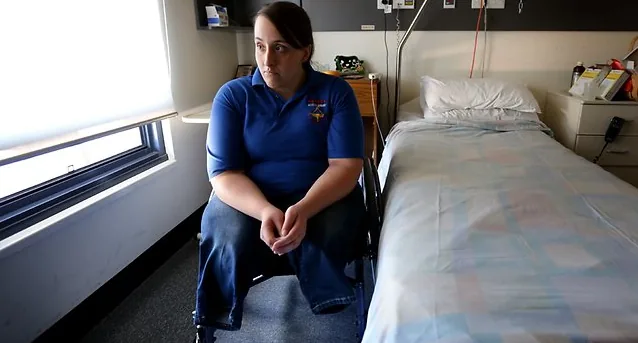
Letting my guard down to receive help was incredibly difficult (not only emotionally, but in accepting physical help) and I can admit to being naturally stubborn. But the shame felt in seeking help needed to be acknowledged and walls had to be broken down. This was by far the hardest part of the process. The innate vulnerability, the thought of having all I know, the stubborn walls, broken down bit by bit was daunting. I felt scared and afraid of coming out worse than what I was when entering the process. The learned vulnerability came through disempowerment, denial of choice and control. Fear of people’s attitudes. I was scared to accept and reflect true self, in more ways than one. I was scared to potentially lose the strength and stubbornness passed down to me from my mother. My environment constantly adds to my vulnerability. A young person (one of over 7,000) existing amongst the elderly, witnessing death and dying on a regular basis.
I was an active 20-something, a busy university student who was hardly at home. Like peers the same age, I had a routine of social life, work, study, and repeat. In the middle of 2012, came the diagnoses of a stage four pressure area and associated health issues, which required lengthy hospitalisation. Due to slow recovery, I was then transferred to a transitional care program within an aged care facility. I felt disempowered by the system, and paranoia and depression set in. The right to have choice and control over where I was to recover was ripped away.
From there, I was transferred to where I am now, and have been for nearly 3 years. In the earlier days of the journey, adjusting to the lifestyle and rigid schedules of the environment was a sobering experience. Consistently witnessing end of life circumstance, death and dying, age related illness – nothing of which a young person should witness. For many months, there was little contact from family and friends. If anything, a rare visit once in awhile. The lack of privacy was disheartening, and the possibility of having a relationship as a result was almost impossible, let alone trying to get time with friends within my environment. Well, not completely, isn’t exactly ‘normal’!
Despite the environment, semi-normalisation is a must. Allowing me to choose (to a degree) how I go about my day and what I want to do. Having (partially) the crazy schedule resembling that of my peers. However, there is still shame when peers come to visit. What young person wants to visit their young friends within an aged care facility?
Despite this, I have tried to defy the constraints of the environment to the best of my ability, and have really stepped outside (metaphorically speaking) from comfort zone in the last couple of years.
Through the experience of vulnerability came strength and determination.
Set No Limits.
Kirrily Hayward
Kirrily Hayward is Clickability’s resident social media geekette. She is also one of over 7,000 young people with a disability residing in aged care nationally. She has been living in aged care for over 2.5 years, with the catalyst being long term illness. Her digital story from the Summer Foundation can be found here.
Clickability editorial update: October 2026
Make the changes you want visible
You can ask to discuss privacy, daily routines, contact with friends or housing without proving you are resilient enough to deserve those choices. Identify the changes that matter most and the assistance you want to communicate them. If you want to explore moving from aged care, current NDIA guidance identifies your NDIS contact or support coordinator as a starting point.
Exploring another option does not require agreeing immediately to a move. Ask what is available, what support would accompany it and what remains uncertain. Choose who, if anyone, you want involved in those discussions.
Address the barrier before judging the person’s resilience
Look at restrictions in the environment and routines, including who controls visitors, activities and private space. Ask the person what they want changed and how they prefer to communicate. Do not treat accepting help as permission to take decisions away. NDIS rights and responsibilities standards provide relevant practice guidance; the author’s account illustrates why the practical details matter.
Questions readers ask
Is the original 7,000 figure current?
No. It is a historical figure in the contributor’s account.
Can a younger participant explore alternatives to aged care?
Current NDIA guidance explains how to discuss other options. Official guidance
Find help exploring support and housing choices
Describe the decisions you want help with and compare support coordinators through Clickability. Ask how they will support your preferences and clarify available options.