Fair Work’s disability sector inquiry: practical checks for providers
The Fair Work Ombudsman's message to providers: you're a high-risk sector, and here's why
By Clickability · Originally published 24 August 2026
Original article and dated context
The Fair Work Ombudsman, Anna Booth, came to the conference with a message every provider needed to hear: as employers, you are under her regulator's spotlight. She opened with a personal disclosure, her daughter Claire, 32, has a moderate intellectual disability and autism, so support workers have been part of her home for decades. That lived experience, she said, gives her empathy for both providers and workers, and a real stake in the sector's future. Then she got to the inquiry.
Why an inquiry, not just case-by-case enforcement
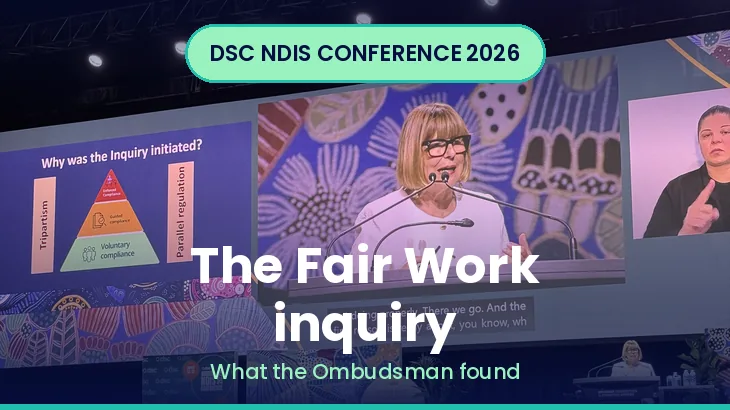
Booth explained the Fair Work Ombudsman's strategic enforcement model, strengthened in 2025. Picture a triangle: at the base, voluntary compliance (an info line taking 300,000 calls a year, a website and advisory services, all aimed at prevention); in the middle, guided compliance through enforcement tools; and at the tip, litigation to secure entitlements and deter others. The whole thing is buttressed by "tripartism" (unions, employers and the regulator working out the right approach together) and "parallel regulation" (working with other regulators, including monthly meetings with NDIS Commissioner Louise Glanville). The point of an inquiry, rather than responding claim by claim, is to find the systemic drivers and have a sector-wide effect.
Why this sector
Her second reason was blunt: the disability support services sector is high-risk, and the regulator picks sectors by sophisticated data analysis. The drivers will be familiar to anyone who lived the last decade: an explosion in demand, rapid and largely unchecked provider growth, very low barriers to entry, and a diversification of provider and employment types. That last one matters, lots of casual workers, high turnover, and workers purportedly engaged as independent contractors and therefore outside many Fair Work Act protections. Add no minimum training requirement, a complex and in parts ambiguous SCHADS award, a vulnerable workforce (a high number of young women, migrants and unqualified workers), and providers under genuine financial strain with high turnover of their own. As she put it, "let a thousand flowers bloom" was the idea behind choice and control, but among the flowers are a few weeds.
Her third reason was the data. In the year before the inquiry was announced, requests for assistance rose 40% and anonymous reports 48%, with around 3,000 investigations completed and about $68 million recovered for workers. On that alone, she said, this is a sector that needs attention.
[Clickability update, September 2026: The conference figures are retained as reported by Clickability, without independent verification here. Do not present them as current totals or assume every figure relates only to this inquiry.]
What the inquiry is doing, and how long
The inquiry runs its scoping and research phase (interviews and forums) through the end of this year, then moves into a deeper, more legalistic investigation and enforcement phase through to the end of 2029, aiming to build collaborative, system-wide mechanisms along the way. It will conclude after Booth's own term ends in mid-to-late 2028. So far the Ombudsman has run open forums around the country (Brisbane, Toowoomba, Bunbury, Perth, Melbourne, Bendigo, Newcastle and Sydney), taken more than 100 written submissions (which can be as short as a half-page email), and conducted around 130 interviews, many with employers, guided by a Disability Support Services Reference Group of unions, employers and the regulator.
She made one pointed request from the stage: the two major employer bodies, National Disability Services and the Australian Industry Group, have been, in her words, "curiously reluctant" to help coordinate their members talking to the inquiry, and she urged them to lend a hand, since a viable, well-run sector is a shared goal.
The themes emerging
Booth pulled out three strong themes. First, award complexity is driving honest mistakes. Second, workers are stretched: interestingly, the inquiry is hearing less about outright underpayment (though that exists, with more than 60 investigations underway, many referred by unions) and more about overtime, sleepovers, out-of-pocket expenses and broken shifts, plus what she carefully avoided calling "time theft", the creep of unpaid minutes that becomes unpaid hours, causing fatigue, breaching rules on breaks between shifts, and risking service quality. Third, businesses are raising concerns about funding caps, razor-thin margins, high administrative workload, costs exceeding funding, and inconsistent, hard-to-find, expensive advice.
She also lifted the lid on joint work most providers never see: the Fraud Fusion Taskforce (which tackles wage underpayment as well as NDIS fraud, alongside the AFP, ATO and Border Force) and a quarterly regulators forum spanning the NDIS Commission, the Fair Work Commission and relevant departments.
How to take part
Her closing ask was participation. Providers, workers, advocacy organisations and participants can all get involved via the Fair Work Ombudsman website or a plain email address, disability@fwo.gov.au, to make a submission, be interviewed, or invite the inquiry to a group. Not everything the inquiry hears is within its control (NDIS pricing, for one), but it will analyse what is driving the behaviours it wants to eliminate, publish it, and lend its voice to change, including to the award over time.
What this means for providers
The clearest takeaway: you are an employer, and a regulator with real powers is watching your sector. Get your award compliance right, the SCHADS award is genuinely complex, so use the Ombudsman's free resources and advisory services rather than guessing. Look hard at overtime, sleepovers, broken shifts and any unpaid-time creep, and at how you engage contractors, because misclassification is a breach even without intent. And consider engaging constructively with the inquiry now, since the enforcement phase from 2028 will be far less forgiving.
[Clickability update, September 2026: Employee-versus-contractor status depends on the arrangement and applicable legal test. Fair Work describes different tests and circumstances; an ABN or contract label alone does not settle the question. Read the current contractor guidance.]
[Clickability update, September 2026: The original elsewhere describes a next phase after 2026, so its dates are inconsistent. The official inquiry page describes a multi-year staged inquiry rather than confirming these exact phase dates. Existing enforcement powers and workplace obligations already apply. Use the official inquiry information.]
What this means for support workers
The inquiry is, at heart, about you being paid and treated correctly. Booth was explicit that being underpaid or denied proper breaks and shift rewards is fundamentally devaluing, and that valued, well-paid workers do better, safer work. Workers are encouraged to know their rights, talk to their unions, and contact the Ombudsman, and can do so anonymously.
What this means for self-managing participants who employ workers
A useful point from the Q&A: participants who self-manage and directly employ support workers become employers with obligations. The Ombudsman's small business employer advisory service can give sole employers a proper hearing and written advice. Booth, who is her daughter's nominee, said she deliberately engages an established provider to avoid that responsibility herself, but the resources are there for those who take it on.
What this means for support coordinators and intermediaries
Understanding that providers face real award-compliance and viability pressures helps you read the market and advise participants, especially self-managers, on the employer responsibilities that come with directly engaging workers.
Q&A
When will the Fair Work Commission fully review the SCHADS award to reflect the modern workforce? Booth couldn't say, as the Commission (led by Justice Adam Hatcher) sets its own agenda, but it responds to approaches from employer bodies and unions. Drawing on her eight years as a Fair Work Commission Deputy President, she said the most powerful move would be for the key parties to sit down together, agree a clearer award, and bring it to the Commission, hard given the adversarial culture and the fear of eroding standards, but not impossible.
Are there resources to help self-managing participants be compliant, good employers? Yes. The Ombudsman's resources and its small business employer advisory service can advise sole employers, including written advice. Booth noted she engages an established provider for her daughter rather than employing directly.
How is the inquiry looking at sham contracting? She drew a careful distinction: "sham" is often misused for what is really misclassification (a breach even without intent), whereas sham contracting involves an intent to mischaracterise an employee as a contractor without reasonable basis. The inquiry expects to find independent-contractor status being used to sidestep award conditions, and will focus on it in the 2028 investigation phase, drawing on the regulator's experience with sham contracting in cleaning, security and road transport.
Meet the speaker
Anna Booth, Fair Work Ombudsman Anna leads the Fair Work Ombudsman, Australia's national workplace relations regulator, and previously served as a Deputy President of the Fair Work Commission for eight years. She spoke with the lived experience of a parent of a person with disability.
Read the full 2027 NDIS changes summary from the reforms reshaping the NDIS to who's expected to stay or go and the crackdown on unscrupulous providers, we've pulled every hot topic and its likely outcome into one quick overview, then gone deeper on each with its own explainer written for both providers and participants, Q&A included. Get the lot in the DSC NDIS Conference 2026 wrap-up.
A note on this series: this is Clickability's plain-English summary of a session at the DSC Annual NDIS Conference 2026, held on 14 August 2026. It reflects our interpretation and is not the official position of the Fair Work Ombudsman, DSC, the speaker or the NDIA, and it is not legal, workplace or NDIS advice.
Clickability editorial update: September 2026
What providers should check in the next roster and payroll review
Choose a real roster and compare recorded hours, required work, breaks, allowances and classification against the applicable award or agreement. Include short tasks outside the roster, rather than checking only the paid shift total.
Sleepover changes took effect from the first full pay period starting on or after 1 June 2026. Check the effective changes and the current SCHADS Award. An NDIS price limit and an employee entitlement answer different questions; funding pressure does not remove payroll obligations.
How workers can prepare a clear pay or roster question
Keep the roster, payslip and a record of the time actually worked. Identify the particular shift, unpaid task or allowance you want explained, then ask for the calculation and applicable classification.
Can employers wait for the inquiry’s next phase to address pay problems?
No. Applicable workplace obligations and enforcement powers already operate. Official guidance
Is the inquiry email the right place to request help with my payslip?
No. The official page directs individual workplace questions to its help channels rather than the sector-experience email. Official guidance
Find support-worker providers and ask how their services operate
Use Clickability to describe the support and communication you need. Compare rated and reviewed profiles, then discuss who will deliver the service and how changes are handled.