NDIS price guide: check support items, limits and your plan
The Complete 2026 Guide to the NDIS Support List and Price Limits
By Clickability · Originally published 16 March 2026
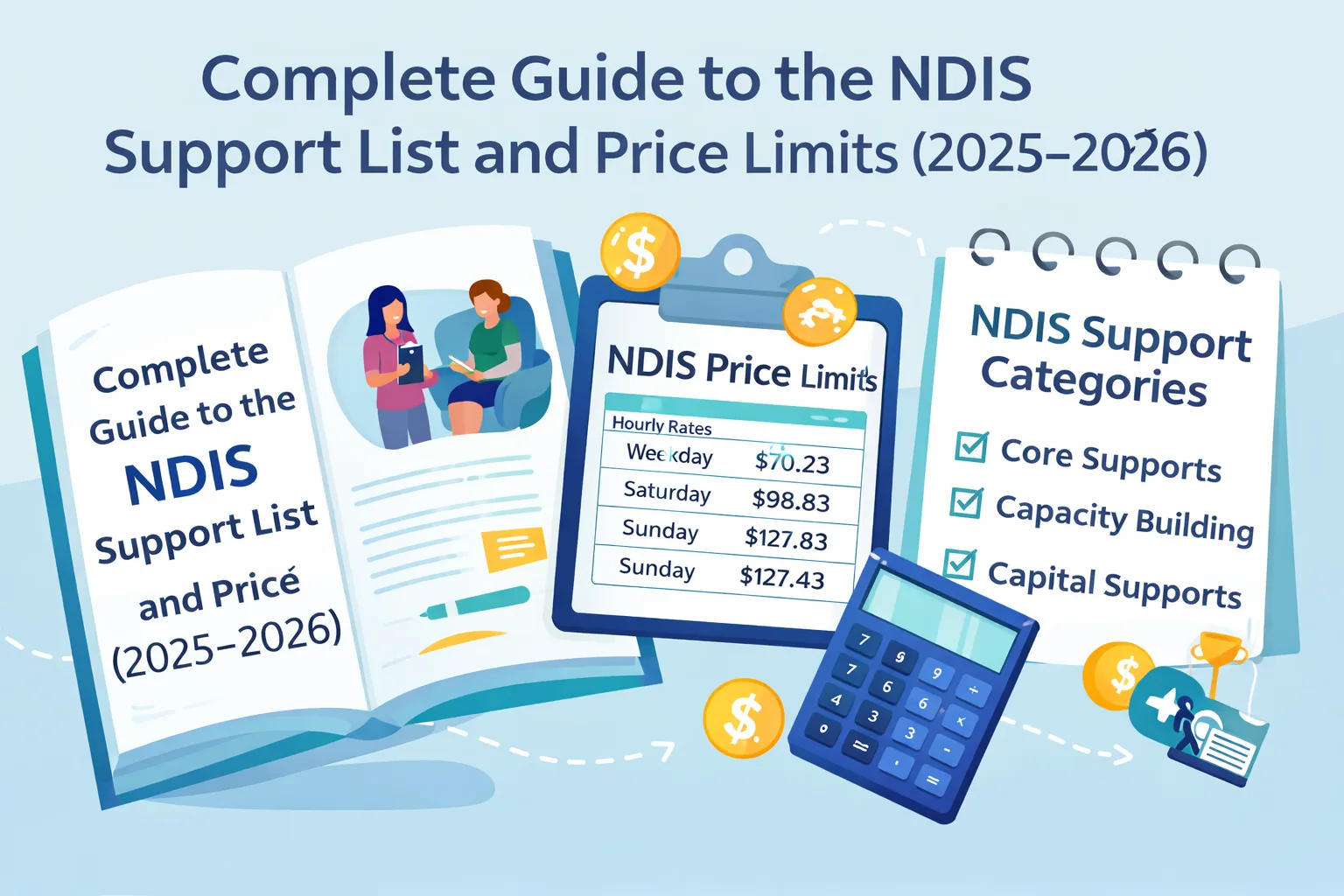
Use the item, the price and your plan together
The schedule checked for this refresh is the 2026–27 version effective 24 September 2026. Use the applicable schedule for the service date, item, activity and location. A maximum price is a ceiling for NDIA-managed and plan-managed funding, rather than the rate everyone must charge. Compare the full booking cost and permitted extras. The support rules and your actual plan decide eligibility; finding an item code does not approve a purchase. Open the official pricing documents.
Original article and dated context
Introduction to the NDIS Support List
- a support item code
- a support category
- a maximum price limit
- rules around how and when it can be claimed
- NDIS participants
- family members and carers
- support coordinators
- plan managers
- NDIS providers
Understanding NDIS Price Limits
[Clickability update, September 2026: The linked Clickability guide is an explanatory resource. Support items are not the same as statutory support categories, and a listed code does not establish funding eligibility. The official pricing page links the current schedule.]
- price limits are usually the maximum, not a fixed fee
- some providers may charge less than the limit
- registered providers must follow NDIS pricing rules where they apply
- self-managed participants may sometimes have more flexibility, depending on the support and arrangement
- consistency
- fairness
- transparency
- sustainability across the scheme
[Clickability update, September 2026: The three-budget explanation is historical. Current NDIA guidance also describes recurring supports. Check the budgets and restrictions shown in your own plan.]
The Three Main NDIS Budget Types
Core Supports
- personal care
- support workers
- household tasks
- community access
- some transport-related supports
Capacity Building Supports
- therapy
- support coordination
- employment supports
- social and life skills development
- plan and decision-making support
Capital Supports
- assistive technology
- mobility equipment
- prosthetics
- home modifications
- specialised disability accommodation
Core Supports Explained
- getting ready in the morning
- showering and dressing
- preparing meals
- attending appointments
- going out into the community
- household cleaning and maintenance
[Clickability update, September 2026: The dollar examples from this point are retained from the original article. Do not use them as current limits or entitlements. Check the September 2026 schedule by item, region and unit before quoting.]
Assistance With Self-Care Activities
- bathing and showering
- dressing
- grooming
- toileting
- transfers and mobility
- assistance with daily routines
- weekday daytime: $70.23
- weekday evening: $77.38
- Saturday: $98.83
- Sunday: $127.43
- public holiday: $156.03
High Intensity Daily Personal Activities
- enteral feeding
- complex bowel care
- urinary catheter support
- ventilation
- seizure management
- diabetes support where applicable under NDIS-funded arrangements
- weekday daytime: $75.98
- weekday evening: $83.72
- Saturday: $106.93
- Sunday: $137.87
- public holiday: $168.81
- staff qualifications
- training
- experience
- whether the provider is set up to safely deliver that type of care
Night Supports
- night-time sleepover at $297.60 per night
- weekday night standard at $78.81
- weekday night high intensity at $85.27
- weekday night intensive and complex behaviour supports at $85.27
- a sleepover may be suitable where support is available if needed
- active overnight support may apply when a worker must remain awake and actively support throughout the night
Assistance With Daily Life
- Assistance with Personal Domestic Activities: $59.06
- Specialised Home Based Assistance for a Child: $59.06
- House and/or Yard Maintenance: $56.98
- House Cleaning and Other Household Activities: $58.03
- Capacity Building and Training in Self-Management and Plan Management: $80.06
- cleaning
- laundry
- gardening
- household organisation
- daily routines
- tasks that become difficult because of disability
[Clickability update, September 2026: The bundled daily prices below are historical. Current STA pricing separates accommodation and support, and STA is not holiday funding. Check current STA purpose and eligibility.]
Short Term Accommodation and Respite
- build independence
- try new environments
- develop social skills
- give informal carers a break
- access structured support away from home
- weekday: $2,178.57
- Saturday: $2,785.13
- Sunday: $3,527.69
- public holiday: $4,270.25
- weekday: $1,198.69
- Saturday: $1,501.97
- Sunday: $1,873.25
- public holiday: $2,244.53
- weekday: $872.06
- Saturday: $1,074.25
- Sunday: $1,321.77
- public holiday: $1,569.29
- weekday: $708.75
- Saturday: $860.39
- Sunday: $1,046.03
- public holiday: $1,231.67
- what is included
- how many nights are funded
- the staffing ratio being used
- whether activities, meals, and transport are built into the cost
Community Participation Supports
- weekday daytime: $70.23
- weekday evening: $77.38
- Saturday: $98.83
- Sunday: $127.43
- public holiday: $156.03
- weekday daytime: $75.98
- weekday evening: $83.72
- Saturday: $106.93
- Sunday: $137.87
- public holiday: $168.81
- attend activities
- build friendships
- participate in community programs
- access sport and recreation
- develop confidence outside the home
Activity Based Transport
- $0.99 per km for a standard vehicle
- $2.76 per km for a modified vehicle
- transport funding paid as a regular amount
- provider travel costs
- activity-based transport connected to a support item
[Clickability update, September 2026: These generalised travel statements do not establish that every provider can charge both directions or the same travel time. Check the applicable item and claiming conditions before agreeing to travel charges.]
Provider Travel
- in service regions MMM 1 to 3: 30 minutes
- in service regions MMM 4 to 5: 60 minutes
- travelling to each participant
- travelling from the participant’s location to the provider’s usual place of work
- do you charge travel?
- how is it calculated?
- is it charged both ways?
- is it split across multiple participants?
Disability Related Health Supports By A Nurse
- Enrolled Nurse: $99.88
- Registered Nurse: $123.65
- Clinical Nurse: $143.04
- Clinical Nurse Consultant: $169.16
- Nurse Practitioner: $176.85
- Enrolled Nurse: $99.88
- Registered Nurse: $123.65
- Clinical Nurse: $143.04
- Clinical Nurse Consultant: $169.16
- Nurse Practitioner: $176.85
Support Coordination
- Level 1: Support Connection at $80.06
- Level 2: Coordination of Supports at $100.14
- Level 3: Specialist Support Coordination at $190.54
- understand their plan
- connect with providers
- troubleshoot service issues
- build capacity to manage supports
- prepare for plan reviews
- coordinate complex service arrangements
Capacity Building Supports Explained
- communication
- emotional regulation
- employment
- learning
- independence
- decision-making
- social participation
Improved Living Arrangements
- finding housing
- maintaining tenancy
- understanding housing responsibilities
- building skills to live more independently
Increased Social and Community Participation
- Life Transition Planning at $80.06
- Skills Development and Training at $80.06
- build confidence
- learn social skills
- work toward greater independence
- prepare for changes in life circumstances
- engage more meaningfully in the community
Finding and Keeping a Job
- Employment Related Assessment, Counselling and Advice: $193.99
- Employment Assistance: $80.06
- Level 2 Coordination of Supports: $100.14
- Psychosocial Recovery Coaching, weekday daytime: $105.43
- Supports in Employment, weekday daytime: $70.23
- work readiness
- job planning
- confidence building
- support in employment settings
- finding and keeping work
- psychosocial support linked to participation and employment
Improved Health and Wellbeing
- Dietitian on managing diet for health and wellbeing: $188.99
- Exercise Physiologist: $166.99
- Personal Trainer: $67.00
- strength and mobility
- physical conditioning
- safer movement
- nutrition support linked to disability needs
- routines that support long-term health outcomes
Improved Learning
Improved Life Choices
- paying invoices
- tracking budgets
- reducing admin stress
- helping participants use a wider range of providers
Improved Relationships
- Specialist Behavioural Intervention Support: $232.99
- Behaviour Management Plan Including Training in Behaviour Management Strategies: $232.99
- Individual Social Skills Development: $80.06
- emotional regulation
- behaviours of concern
- social interaction
- relationship skills
- building safer and more supportive routines
Improved Daily Living Skills
- Psychologist: $232.99
- Physiotherapist: $183.99
- Occupational Therapist: $193.99
- Speech Pathologist: $193.99
- Podiatrist: $188.99
- Therapy Assistant Level 1: $56.16
- Therapy Assistant Level 2: $86.79
- Art Therapist: $156.16
- Audiologist: $193.99
- Social Worker: $193.99
- Counsellor: $156.16
- Developmental Educator: $193.99
- Exercise Physiologist: $166.99
- Orthoptist: $193.99
- Rehabilitation Counsellor: $193.99
- Music Therapist: $156.16
- Assistance With Decision Making, Daily Planning and Budgeting: $70.23
- Individual Skill Development and Training Including Public Transport Training: $70.23
- Training For Carers/Parents: $80.06
- Community Engagement Assistance: $51.20
- Selection and/or Manufacture of Customised or Wearable Technology: $193.99
- Dietitian: $188.99
- Provision of Hearing Services by an Audiologist: $193.99
- Provision of Hearing Services by an Audiometrist: $166.83
- Other Professional: $193.99
- Assistive Technology Mentoring: $105.43
- Early Childhood Teacher or Educator: $193.99
The NDIS Support Categories Explained
1. Accommodation Assistance or Tenancy Assistance
2. Assistance Animals
3. Assistance in Coordinating or Managing Life Stages, Transitions and Supports
4. Assistance to Access and Maintain Employment or Higher Education
5. Assistance With Daily Life Tasks in a Group or Shared Living Arrangement
6. Assistance With Travel or Transport Arrangements
7. Assistive Equipment for Recreation
8. Assistive Products for Household Tasks
9. Assistive Products for Personal Care and Safety
10. Specialist Positive Behaviour Support
11. Communication and Information Equipment
12. Community Nursing Care
13. Prostheses and Orthoses
14. Daily Personal Activities
15. Development of Daily Care and Life Skills
16. Disability-Related Health Supports
17. Early Intervention Supports for Early Childhood
18. Exercise Physiology and Personal Wellbeing Activities
19. Group and Centre Based Activities
20. Hearing Equipment
21. High Intensity Daily Personal Activities
22. Home Modification Design and Construction
23. Household Tasks
24. Innovative Community Participation
25. Interpreting and Translation
26. Management of Funding for Supports
27. Participation in Community, Social and Civic Activities
28. Personal Mobility Equipment
29. Specialist Disability Accommodation
30. Specialised Driver Training
31. Specialised Hearing Services
32. Specialised Supported Employment
33. Support Coordination
34. Therapeutic Supports
35. Vehicle Modifications
36. Vision Equipment
[Clickability update, September 2026: This historical summary is not a complete current list of stated supports. Use your actual plan wording and the current NDIA budget guidance rather than inferring permission from a category heading. See current budget guidance.]
Supports That Must Be Stated in the Plan
- accommodation assistance or tenancy assistance in certain contexts
- assistance animals
- specialist positive behaviour support
- high intensity daily personal activities
- home modification design and construction
- innovative community participation
- management of funding for supports
- specialist disability accommodation
- specialised driver training
- support coordination
[Clickability update, September 2026: A replacement support needs written NDIA approval before purchase. It is not automatic because an item could be useful or appears in this section. See the replacement-support process.]
Replacement Supports
Standard commercially available household items
- is necessary to address disability-related needs
- increases whole task independence
- reduces or eliminates the need for a support worker or disability-specific assistive technology
Smart watches, tablets, smartphones and apps used for accessibility or communication
- replace one or more other NDIS supports
- cost the same as or less than the supports it replaces
- provide the same or a better outcome for the participant
[Clickability update, September 2026: The arithmetic examples use the historical rates above. Replace the input rate with a verified current quote and allow for other agreed costs before using them to budget.]
A Simple NDIS Price Calculator Guide
Example 1: Support Worker on a Weekday
Example 2: Support Worker on a Saturday
Example 3: Support Worker on a Sunday
Example 4: Psychology Support
Example 5: Physiotherapy Support
Example 6: Support Coordination
How Participants Can Use the Support List
- understand what supports may be available
- compare provider quotes
- better understand invoices
- estimate how long budgets may last
- prepare for plan reviews
- make more informed decisions about providers
- what support item code are you using?
- what is your hourly rate?
- do you charge travel?
- how will this affect my budget over time?
- is this support included in my plan?
How Providers Use Support Item Codes
- create service agreements
- issue invoices
- submit claims
- align services to plan categories
- whether the support can be claimed
- what price limit applies
- whether the support matches the participant’s funding
Practical Tips for Participants and Families
1. Price limits are not always what you will pay
2. Timing matters
3. Not every support is flexible
4. “NDIS funded” does not mean “automatically approved”
5. Ask for clarity before services begin
How Clickability Can Help
- search for NDIS providers
- compare services
- read reviews
- explore support categories
- send service requests
Finding NDIS Providers
- search thousands of NDIS providers
- compare services
- read verified reviews
- send service requests
Final Thoughts
- what kinds of supports may be funded
- how those supports are grouped
- what the maximum price limits are
- where participants need to pay special attention
How participants should compare a provider’s quote
Ask for a written quote that separates the delivered support, hours or units, rate and proposed extras. Compare the same service and the same period. A lower hourly price can still produce a higher total if the quote includes more hours or separate charges you did not expect.
| Support and item | National maximum | Why the detail matters |
|---|---|---|
| House cleaning: 01_020_0120_1_1 | $60.10 per hour | Compare with the historical $58.03 example below. |
| House or yard maintenance: 01_019_0120_1_1 | $59.01 per hour | Use the item for the actual work, not a generic household rate. |
| Occupational therapy direct service: 01_661_0128_1_3 | $193.99 per hour | The provider-travel item has a different maximum. |
These are selected national examples, not a complete rate card or an entitlement to funding. The official schedule, pages 34 and 47, also lists remote and very remote prices and distinct claim types.
Before you agree, ask: “What will one typical week cost, including the extras you propose?” Then ask what changes if an appointment is cancelled or the service takes longer. Put the answers beside your available budget rather than comparing only a headline rate.
A worked budget example for participants and families
For an eligible cleaning support quoted at $55 an hour, two hours a fortnight over 26 visits totals $2,860. At the selected national maximum of $60.10, the same hours total $3,125.20. The $265.20 difference is a comparison of agreed service prices, not a promised saving. This illustration excludes any separately agreed, permitted charges and assumes funding covers the full period.
If you help a family member compare quotes, keep their preferred worker, communication needs and service quality in the conversation. A useful comparison records both the total cost and what each provider will actually do. Let the participant decide which trade-offs matter.
How plan managers and support coordinators can use this guide
Ask the participant which decision needs resolving: affordability, the correct support item, funding eligibility or an unexplained invoice. Keep these questions separate so a price comparison is not mistaken for permission to buy a support. A plan management service can help with the invoice process; raise an unresolved funding question with the participant’s NDIS contact before committing their money.
Compare each proposal over the participant’s actual funding period. Where several providers share a budget, put their proposed costs together and identify the remaining amount. Record assumptions, including service frequency and proposed extras, so the participant can see what would change the estimate.
What providers should check before reusing an invoice code
Recheck the current item, unit, region and delivered service when documents change. Do not carry an old code forward simply because the worker or participant is unchanged. Keep the effective schedule with the quote and explain the difference between direct service and any separately proposed travel, cancellation or other work.
The official pricing page still links older 2025–26 claiming guidance while updated guidance is being prepared. That older document must not displace the current maximum-price schedule. For an unresolved claim condition, obtain clarification before billing and keep the answer with your records. Check the official pricing documents.
Price limits and support budgets can change separately
The NDIA announced reductions for Social, Economic and Community Participation and Improved Daily Living Skills, with specified exemptions. They apply as plans are created or reassessed from 1 October 2026, or renewed from 1 February 2027. Check your own plan and the NDIA’s commencement and exemption details; a higher price limit does not itself mean your budget has increased.
Questions readers ask
Where can I download the current NDIS price guide?
Use the official NDIA pricing page and select the 2026–27 schedule effective 24 September 2026. It also identifies the separate SDA schedule. Check the effective date rather than relying on a search-result year. Official guidance
Is a provider required to charge the maximum price?
No. Ask for the provider’s actual agreed price and a total quote for the service period, including proposed extras. Official guidance
Does an NDIS support code approve my purchase?
No. The purchase must satisfy the NDIS support rules and fit your plan. Resolve eligibility before committing to a service. Official guidance
Is the NDIS price guide a support worker’s wage rate?
No. A provider’s support price and an employee’s wage are different amounts. Do not read a billable support rate as the worker’s take-home pay. Official guidance
Find a provider and ask for a clear quote
Explore Clickability’s network of 5,000+ vetted providers across the platform. Describe the service you need and compare a provider’s quote with your plan before agreeing.
Find providers for my funded support · Browse the provider directory