Telehealth consultations: preparing for remote exercise support

Telehealth: What is it and how does it work?

By Cassie Hovey · Originally published 15 April 2020

Clasped hands beside a laptop on a desk

Original article and dated context

Cassie Hovey is an exercise physiologist who recently made the move into Telehealth. She works with people of all abilities, implementing exercise programs and interventions to improve quality of life and guide people towards their goals.
Telehealth is a form of health care we previously heard little about in metro areas, with it used primarily for people living in regional Australia. It was the only way many could receive treatment.
However, with the changes in the world and Australia during COVID-19, Telehealth has quickly become the ideal method for practitioners to deliver information, as we’re able to maintain social distancing with our clients.

[Clickability update, October 2026: This is the historical pandemic context. Current Australian Government information describes phone or video consultations when clinically appropriate; some care requires an in-person assessment.]

This is what you need to know about it.

What is Telehealth?

According to our beloved Google, Wikipedia has defined it as “the distribution of health-related services and information via electronic information and telecommunication technologies. It allows long-distance patient and clinician contact, care, advice, reminders, education, intervention, monitoring, and remote admissions.”
Basically, it means a phone-to-phone or video-to-video method of communication from one person (clinician) to the next (you). It’s kind of like Skype – but we (clinicians) typically use platforms that meet specific criteria for the Australian population.

What if technology isn’t your greatest strength?

That’s fine! It really is quite simple. If you have the technology (read below) and a basic understanding of how to use technology, you will be fine. Often, the clinician can simply email you a link that will take you to the platform. If you need help, assistance is available! Your clinician is here to help.

What technology is required?

An internet connection, camera and a microphone. Cameras and microphones come standard in most devices (laptop, tablet, phones) released in the past 5 years.
There are different platforms (webpages/apps) available to use, each with its pros and cons. The one you use will typically depend on the clinician and what they already have set up.

What does it look like?

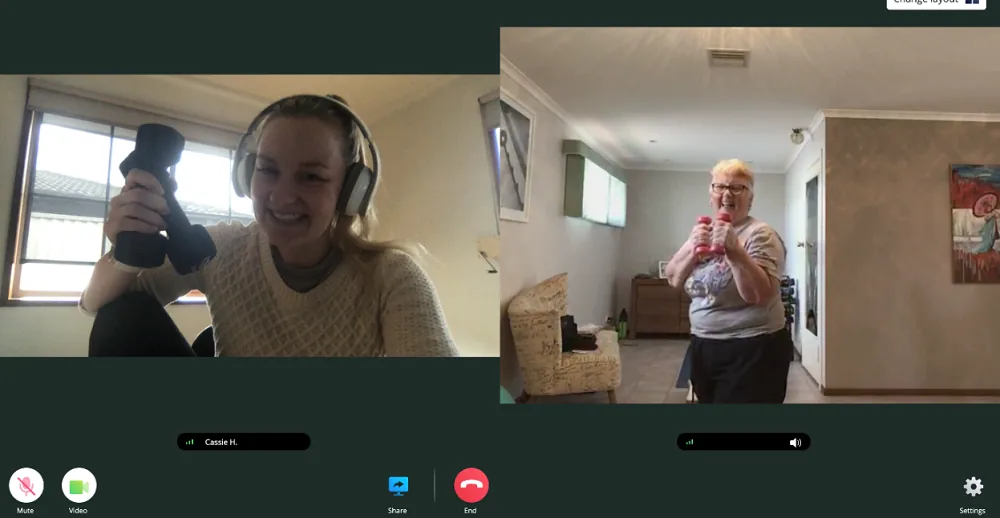
Well, just like this! Here’s just a screenshot of a conversation I had the pleasure of taking part in this morning.
Cassie Hovey and client on a telehealth interface. Displays videos of them talking to each other.
As an Exercise Physiologist, the way I work with different people, is in fact, quite different – for some, we mostly discuss exercise, its benefits, how they can change lifestyle behaviours or how exercise could be of benefit.
Often, for ongoing clients, we set the screen up so the client can exercise whilst I instruct, observe and give tips and encouragement along the way to keep them moving in order to reach set goals.
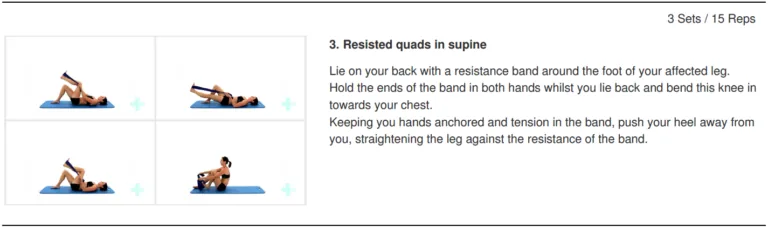
Post Telehealth sessions, I also communicate with my clients. Here’s an example exercise program I send, breaking down an exercise with pictures and more in-depth descriptions.
A diagram of someone completing stretches, with a description of those stretches.

Historical example only: the handout illustrates resisted quadriceps movement while lying down, using a resistance band, and gives sets and repetitions. It is not a personal exercise prescription. Ask your practitioner for a program suited to you.
I often use these programs to keep my clients moving throughout the week, whether it’s a full program or two exercises to focus on. Really, it comes down to the individual and their goals.
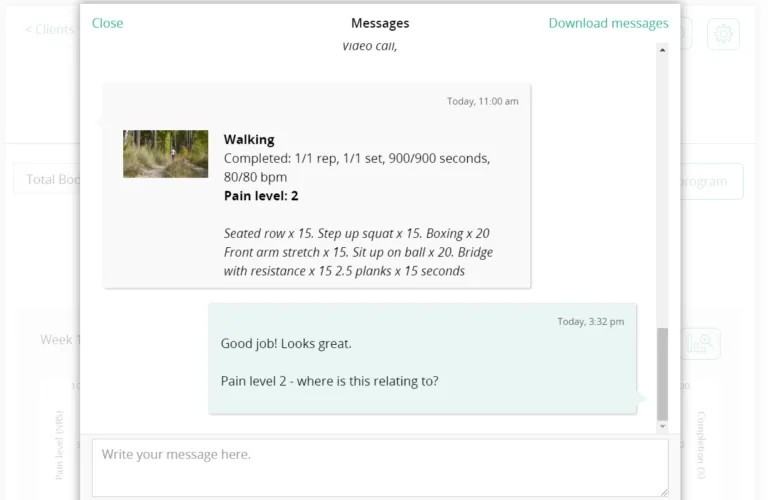
A chat exchange between clinician and client.

Historical example only: a message records a walking activity, exercise notes and a pain score, followed by a question about the location of pain. This illustrates follow-up communication, not instructions for the reader.

Another positive I’ve found after implementing this service with clients is that we can continue to communicate about how things are progressing between appointments, not just the weekly or monthly appointments that are otherwise planned.

What should you do to prepare for an exercise-based Telehealth call?

There are many ways we can ensure the time we have is used most efficiently, and none of it is even slightly difficult!

[Clickability update, October 2026: Technology, communication and access needs vary. Ask for the assistance or alternative consultation format you need; do not assume these preparations are easy for everyone.]

  1. Set up in a quiet, well-lit area
  2. Ensure the camera and microphone are working, open the camera, make sure you can see yourself clearly, and open the microphone and ensure its recognizing sounds. This can typically be done by searching ‘camera’ or ‘microphone’ and opening the application there.
  3. If you have any exercise equipment, find it and have it in the room with you prior to commencing the appointment.
  4. If you haven’t met your new practitioner before, make sure you have any questions written down, to discuss straight away.
  5. Ensure you have room around you if we need to do a little exercise. If you can stand up with your arms outstretched as far as they can with extra room around you still, this will typically suffice.
Hopefully all the above gives you a little peace of mind or clarity as we move into Telehealth systems throughout 2020!

Clickability editorial update: October 2026

How participants can prepare a telehealth appointment that works for them

Ask whether phone, video or an in-person appointment best suits the consultation. Discuss communication needs, a private place and what to do if the connection fails. Current telehealth information explains remote consultation options.

For exercise, ask the practitioner about your own space, assistance and safety requirements. The screenshots illustrate the author’s historical practice; do not copy the exercise or repetitions as a personal program.

Confirm suitability and access before giving a remote program

Agree how the person will communicate, what equipment and assistance are needed and what happens if an in-person assessment becomes necessary. Do not treat a working camera as evidence that an exercise is suitable. Explain costs, privacy arrangements and follow-up in a format the person can use.

Questions readers ask

Does every telehealth consultation need a camera?

No. Telehealth can be by phone or video, depending on the service. Official guidance

Should I copy the exercise in the screenshot?

No. It is a historical example, not an individual prescription.

Find exercise physiology services to discuss your needs

Use Clickability to describe the assistance you want from an exercise physiologist. Compare reviewed and rated profiles and ask about suitability, access and consultation options.

Find an exercise physiology provider · Browse exercise physiology providers

Related articles