University disability support: Jo’s advice on finding your path into study
Jo’s Top 5 Tips to Higher Education
By Jo Garvin · Originally published 20 October 2015
Original article
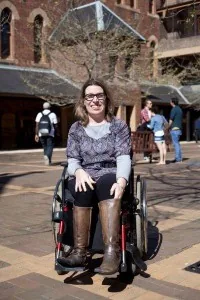
Jo Garvin studied Communications and Media and is a 2011 recipient of the Joey Mittaga Award and the Lionel Bowen Scholarship. She hopes to work in film, theatre and social justice.
I was not very academic at school, learning wasn’t easy for me. So with all these factors in mind going to university did not seem achievable. Luckily though, I have parents who have very high expectations of me and have always valued education. So, if you are thinking about going to University or TAFE my advice to you would be to do your research, plan, talk to different people at the uni’s you are interested in going…
1. Find out your options
In year ten like many people coming to the end of school I was very anxious about doing the HSC and what I wanted to do after finishing high school. I also had the challenge of teaches not wanting me to do the HSC because they felt that it would be far too difficult for me to complete. My Mum fought for me and said ‘no’, I would do my HSC and do pathways*. And so that is what I did. I completed my HSC over two years; the first year at school and then my second at Tafe. A few people questioned my choice of going to Tafe, but even though it was challenging at times it gave me a great taste of what Uni would be like. No one was chasing me up on my assignments; I started to become more independent and loved this new sense of freedom in being able to choose what I wanted to do.
2. Talk to different people and find what fit you
When it came time to think about which Uni to go to I had decided to apply to the University of Notre Dame. A friend of mine had gone there and loved it. It just sounded like a great place for me to go to, it was small and seemed very focused on partial care. I also loved that an internship was part of the Communications and Media Course. Most importantly, Notre Dame weren’t too concerned about a persons ATAR score, but more about you as a person and what you could bring.
3. It’s hard… so take your time
I can still remember my first day of uni sitting in a lecture thinking “I can’t believe that I am actually sitting in a lecture listening to a lecturer of all things”. I have absolutely loved being a student at Notre Dame; of course it has been challenging especially in the first year when I didn’t quite know what I was doing. Trying to learn to be organised and trying not to feel overwhelmed in that first year and trying to manage my study load was extremely challenging . What was particularly challenging was doing four subjects that semester. I just found it to be too much so I decided to drop to three subjects, which was far more manageable for me and a lot less stressful. It has also been rewarding and such a confidence builder. I have met some really interesting people, made life long friends, become far more confident in myself and to be honest, enjoyed going to Uni far more then being at school.
4. Ask for help and then take it
I found that the disability coordinator was able to help have things accommodated for my needs and me. I was able to get special provisions for exams, like having a reader and writer and extra time to complete exams, which helped to make uni a level playing field for me.
5. Do things you enjoy
I have been doing subjects that I have loved. I have become more articulate and I have enjoyed being treated as an individual (pardon the clique but it’s true). My favourite subject at uni was film studies because my lecturer was extremely passionate and as part of the subject we got to watch movies every Monday and as a result I want to work in the film industry.
Thanks to uni and the experiences and opportunities I have been given there, I have realised that I can do anything I want in life and I don’t feel as anxious about the future as I once did. From my experiences, I have learnt that knowledge is power and the most important thing is to have confidence in yourself and your ability.
*Pathways describe the options available to students to gain the final school year qualifications more flexibly. Each State and Territory works differently, so speak to your school about your options.
Clickability editorial update: September 2026
How students can turn Jo’s experience into useful questions
Before choosing a course, contact the institution’s disability or access team. Describe the barriers you expect in classes, assessments, placements or travel around campus. Ask what information the team needs and how proposed adjustments will be discussed with you.
Compare courses on more than admission requirements. Ask about timetable flexibility, placement access, study load and who to contact when a subject’s arrangements change. Keep a record of what has been agreed so you do not have to start the same conversation with every new staff member.
The Disability Standards for Education address access and participation on the same basis as students without disability. The Department of Education explains the Standards. Use the institution’s process to discuss your circumstances; Jo’s particular exam arrangements do not establish what will be appropriate for every student.
How families can support the student’s decisions
Offer help researching access or preparing questions, and ask which parts the student wants to handle themselves. A quieter study load or a different pathway can be a deliberate choice, as Jo describes. Compare how each option fits their interests and practical needs rather than treating one timetable as the only successful route.
Should I wait until classes start to ask about disability support?
Contact the institution early so you can understand its process and discuss the access needs of your course. That gives you time to identify questions before enrolment or assessment deadlines.
Does Jo’s story promise the same adjustments at my university?
No. Her account is personal. Discuss appropriate adjustments and the institution’s obligations with its access team. Official guidance
Find support around the study path you choose
Need disability support alongside study? Tell Clickability what help and location you need, then compare provider profiles and reviews while keeping education arrangements with your institution.