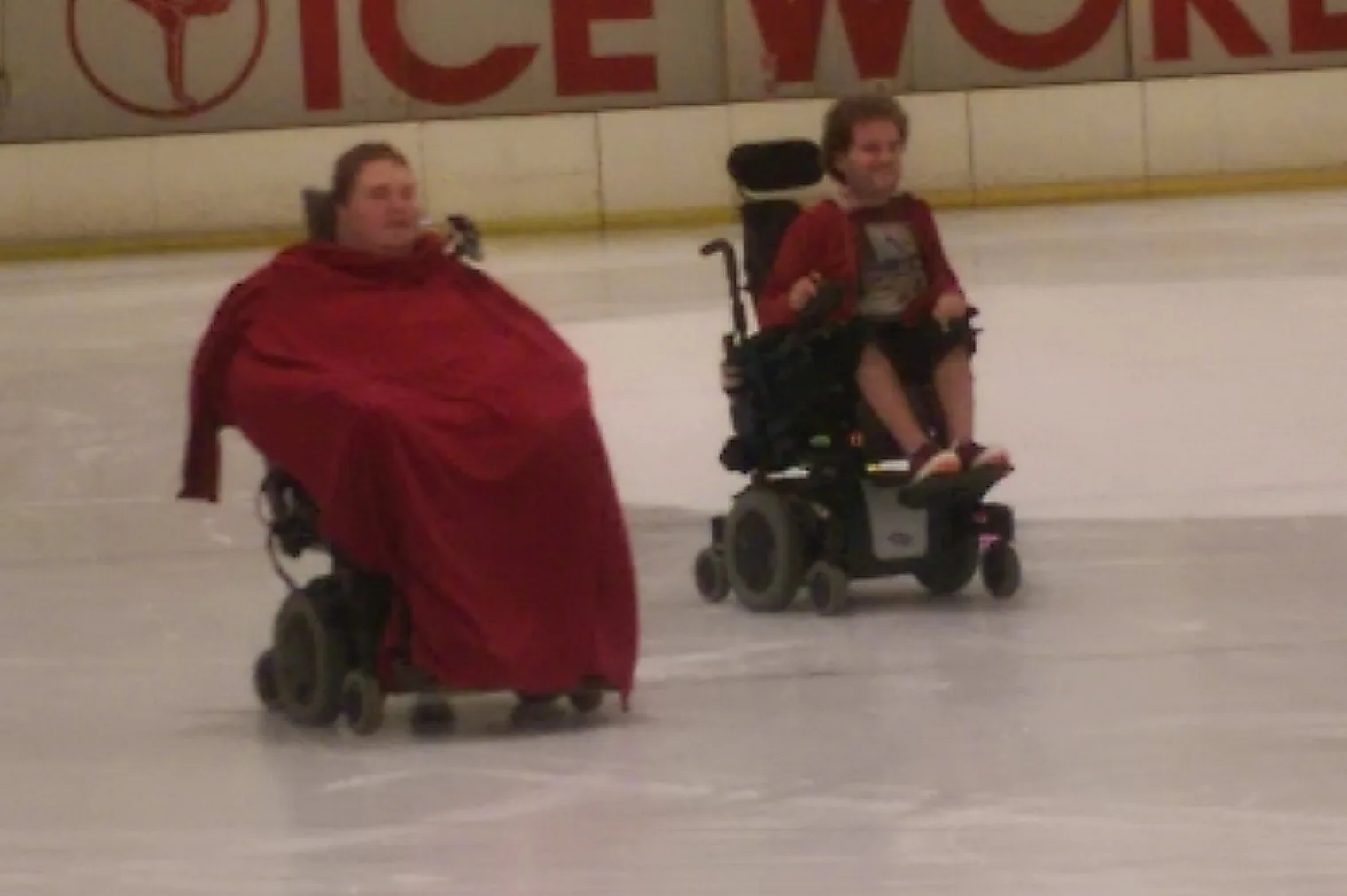
Wheelchair access and belonging: an ice-skating experience
On wheelchairs and ice-skating
By Tristram Peters · Originally published 16 March 2016
Original article
Last Friday, for only the second time in my life, I went ice-skating. The rink was bitterly cold, causing a dulled brain freeze and a painful numbness in my hands, but I needed to make the most of the opportunity. Let’s be honest – it’s not every day an ice rink owner allows a wheelchair user onto the ice.
I’ve been in the wheelchair since the age of three. I have the wonderfully titled Spinal Muscular Atrophy Type II, which, as I’ve written about before, turns my body into a ragdoll. I can’t stand or walk, dress or shower myself, but I can’t remember ever doing those things. I’m blessed by this in a weird, perverse way, because I think it’s helped me accept the wheelchair life.
Undoubtedly, I still get annoyed by a few things. For instance, don’t ever say I’m wheelchair bound. I’m not physically tied to the wheelchair, am I? I’ve also been invited to parties with steps and I’ve been stuck in elevators because I can’t reach the goddamn button.
Because of this, I believe in a social model of disability, not a medical one. As the late Stella Young said, it’s not our medical diagnoses that limit our success, but society’s frequent inability to adjust to points of difference. See, if you built a ramp, I could get into that party; if you lowered those buttons in the elevator, I could get to the fifth floor in time for my class.
For me, this is why studying and working were so important. They were chances to develop the necessary skills to bring about change. I studied journalism, arts and history, because I believe that words have weight and power. University and employment were the means to raise awareness and prove that the wheelchair wasn’t always an impediment.
Each has its own challenges. For instance, I sometimes had to explain to lecturers that I physically cannot write in an exam for two hours straight without my hand seizing up. However, the disability services were brilliant, helping me whenever I needed a hand. Throughout my degree, even the access at university has improved – lifts are built and ramps constructed – while classrooms were quickly changed if they proved inaccessible. Meanwhile, I’ve scored a job at a public relations firm, where I feel my wheelchair does not matter, as it rightly shouldn’t.
The wheelchair is part of my life. It doesn’t define me, but it’s definitely part of who I am. Every now and then, it throws up the odd curveball, but I’ve quickly learnt that I need to seize on any opportunity I can, whether that be at uni or work. Sometimes, I can even forget the wheelchair exists and do simple, silly things like ice-skating. Who would have thought it?
Tristram Peters
Clickability editorial update: October 2026
Ask about the access details that decide whether you can join
Describe the features you need and request specific information about entry, toilets, equipment, communication and assistance. An enthusiastic invitation or a generic accessible label may leave important questions unanswered. You can ask for a different arrangement if the suggested one does not work for you.
For outings, Austrade’s accessibility framework illustrates the value of clear details. Agree what help you want instead of assuming participation means doing every task alone. The purpose is to join the activity on terms that suit you, not prove that you can tolerate every barrier.
Look for the barrier you can change
Speak to the person about what prevents participation: the entrance, information, room location, timing or assistance arrangement. Ask before offering help and explain what can be changed. Do not treat a wheelchair as a complete description of the person’s interests or capacity.
For an NDIS service, use rights and communication standards to guide the conversation. Record practical preferences and follow through on agreed arrangements. Avoid promoting one successful event as evidence that all your activities are accessible.
Questions readers ask
Does the essay confirm current ice-rink access?
No. Contact the relevant venue about its current arrangements.
Does removing a barrier mean everyone needs the same assistance?
No. Ask about individual preferences and needs.
Find assistance for the experiences you want to have
Tell Clickability about your activities and access needs. Compare reviewed and rated support providers and discuss the help you want.