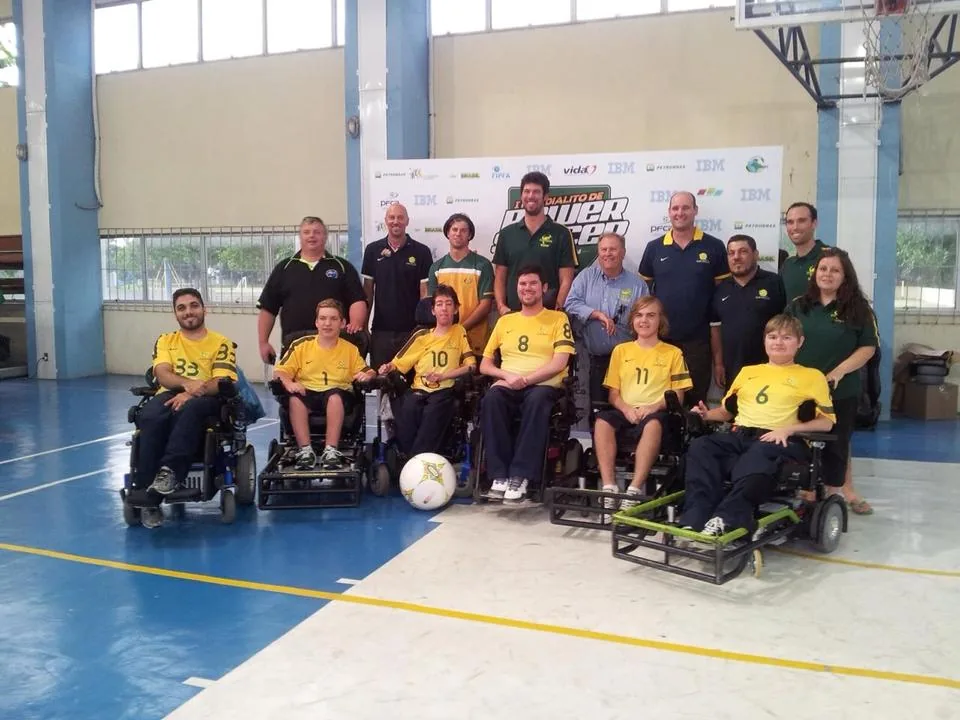
Powerchair football and overseas travel: Chris’s team experience
Powerchair Football abroad in green and gold
By Chris Suffield · Originally published 27 January 2016
Original article
Chris is a 26 year old Sydneysider, a sports tragic and an avid Sydney Swans fan. Chris has played wheelchair sports from a young age, including rugby league, hockey and football. He is especially passionate about the sport of powerchair football, having represented both New South Wales and Australia while also sitting on boards for the sport at state and national level.
Powerchair football is a version of football for people who use power wheelchairs, with athletes using bars attached to their chairs to pass, dribble and shoot with an oversized soccer ball. It allows athletes with many different conditions, such as Muscular Dystrophy, Cerebral Palsy, birth defects and many others, to compete at a local, national or international level. The sport is growing rapidly around the world and in Australia and is giving many more athletes the chance to wear green and gold.
With the announcement that the FIPFA World Cup for powerchair football will be held in Florida in July 2017, I spent some time reflecting on my trip to Rio de Janeiro in May 2014 as part of the Australian Poweroos team that competed in the first Copa Americas tournament.
Anyone who has travelled overseas with their wheelchair would know what a logistical nightmare this can be, and this was the same for us, but multiplied by two. The development of powerchair football now sees athletes playing in wheelchairs specifically designed for the sport. But these chairs are not suitable (or comfortable enough) for day to day use. So for a team of 6, we brought 12 wheelchairs with us.
Now the obvious way to fly to Rio from the east coast of Australia would be straight across the Pacific, right? A little stop in Buenos Aries or Santiago and you’re right there. But as always, we chose to do things the hard way. Many airlines refuse to take more than a couple of wheelchairs on a single flight. This has been a problem for many of my sporting friends in different states. However, when Australia sent a team to the 2011 FIPFA World Cup in Paris, Emirates were happy to take a similar number of chairs on the one flight. So we decided to use the same carrier. You’re probably already thinking that all Emirates flights go through Dubai, right?
That’s right. To get to Rio, we flew the wrong way around the world, stopping in Dubai for all of 90 minutes (and even holding up our connecting flight) before continuing, meaning we were in the air for around 30 hours each way. That’s far too long for anyone. Even with a cushion from my wheelchair on my plane seat I still couldn’t feel my backside at the end of the flight. But that’s what you go through to play the sport you love, right?
When we arrived in Rio, there were two rental vans to pick us up, with only enough space for 6 chairs. What did they have for the rest of the chairs? A truck with no lift. So the men in our group shouldered arms and lifted 6 chairs into the truck. The hurdles you have to jump simply make things more interesting.
Aside from all of these issues, the trip to Rio was a massive success. Through the group stages, we held Brazil, Argentina and Uruguay scoreless while scoring ourselves, took the game right to the end in a loss against Canada and scored against the World Champs, the USA. And our semi-final against Canada was an epic where we came from behind three times and hit the lead right at the end to win 4-3. Unfortunately the USA taught us a lesson in the final, winning 6-0, but we were so proud to achieve our goal and reach the final. We won the silver medal against some fantastic teams and had finally arrived on the world stage, learning a great deal from some of the top athletes in the sport.
And on top of that, we even had some time to be tourists. We visited Copacabana Beach and even sat on the beach in our wheelchairs on special plastic mats. We went on a tour of the Maracanã, Rio’s most famous football stadium, and saw a Brazilian league match too. We might not have had a lot of time to let our hair down, but it was a trip I’d go on again in a heartbeat.
When the Australian Poweroos set off to Florida for the 2017 FIPFA World Cup, they’ll be going on an adventure they’ll never forget. Good luck for all the athletes hoping to be selected. It’s going to be a busy 18 months!
Clickability editorial update: October 2026
Plan around your equipment and the assistance you want
Ask the airline and transport operator about the actual equipment you intend to take, including dimensions, batteries and handling arrangements. Confirm each leg rather than assuming an old experience with a carrier guarantees today’s acceptance. Keep the information available to the people travelling with you.
Discuss the help you want at the airport, accommodation and activity. Smartraveller disability travel information provides a starting point. Separate travel expenses from any disability-related support and check applicable NDIS rules before committing funds.
Agree the travel role before departure
Discuss the participant’s routine, equipment and preferred assistance, including what happens if a connection or vehicle arrangement changes. Make sure the support agreement and staffing arrangements fit the trip. Being part of a sporting journey does not remove professional boundaries.
Do not copy the improvised equipment lifting described in the story. Confirm appropriate handling with the relevant operator and participant. The Code of Conduct provides context for safe, respectful support; a successful historical trip is not evidence that every workaround is suitable.
Questions readers ask
Are the tournament dates current event information?
No. They belong to the historical account.
Does this story confirm an airline’s current wheelchair policy?
No. Confirm the actual equipment and arrangements directly.
Find assistance for the activities you want to join
Tell Clickability about your participation and travel-support needs. Compare reviewed and rated providers and discuss the help your plans require.