Accessible tourism in South Africa: Karen’s visitor experience
What do elephants have to do with accessibility?
By Karen Day · Originally published 30 November 2016
Original article
In January this year I took my two sons on a trip to South Africa where I grew up, to see some of their heritage, now that we’re living in New Zealand. My lifelong friend, Mandy, insisted that we spend time with elephants and she knew exactly where she wanted us to go.
Adventures with Elephants is a rescue and research centre for elephants and other animals that live in their world, such as giraffes, monkeys, and meerkats. It was a very hot, typically African day. Broad blue cloudless skies. The thorn bushes of the region north of Johannesburg stretched out endlessly in the wide, long horizon.
With her wheelchair in the back, and the aircon on high, Mandy took us on the long drive to a town called Bela Bela, near where the elephant sanctuary is situated. I remembered the town from my childhood when we occasionally had a family holiday at the hot pools, but the town had changed a lot over the years, as one would expect, even though the African scenery hadn’t.
It was 41 degrees by the time we arrived at the sanctuary, which was a brief trip on the other side of Bela Bela. The heat struck us like a physical force when we got out of the car. We made our way to the main building where we hoped to get a cool drink.
Mandy had suggested Adventures with Elephants because she had been invited to assess the facilities for accessibility; she’s an accessibility consultant. We had been disability rights activists together in the 1980s and 90s until I moved to New Zealand in 1999. It was good to accompany her on this task and work together again (in addition to the pull of spending time with elephants).
After the two-hour drive, we were both busting and made our way to the toilets, which were not accessible to Mandy without my assistance. We were both a bit uncomfortable about this, having developed the mindset so long ago that everyone should have access everywhere, especially in light of the building laws and code of practice that we influenced in the 1980s.
When we came around to the front of the building to meet the owners and go through the programme of meeting the elephants, hearing their stories, and going for a ride, we saw that Mandy would need assistance again to get onto the deck where tables and chairs were spread out invitingly. Our noon appointment started soon after we arrived and so we moved on to the space where we were to meet the elephants.
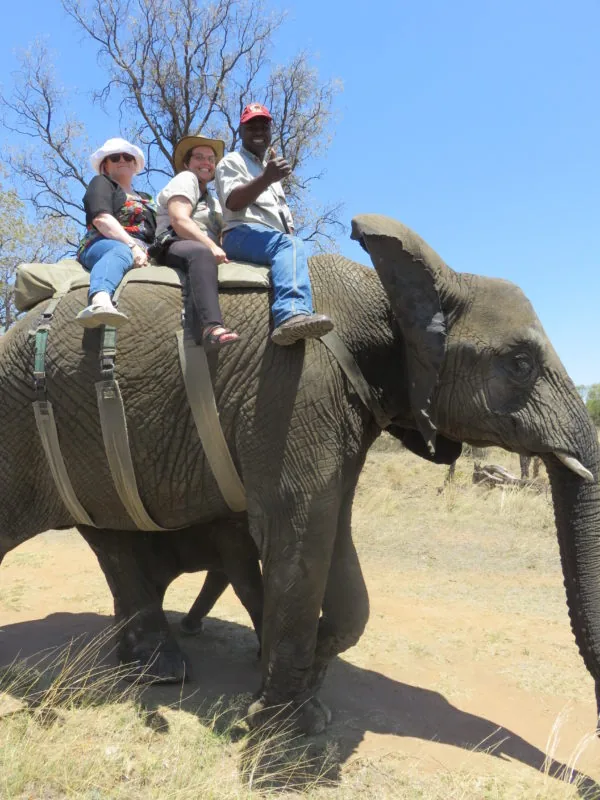
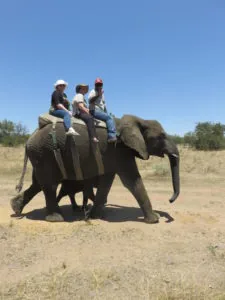
Karen and Mandy riding an elephant with Adventures with Elephants in South Africa
Ah, what grand creatures they were! We met the elephants, one by one, and were told each elephant’s story of trauma and rescue. We could see how much their attendants loved them, and enjoyed the humour they wove into the stories and interactive activities they had planned and practiced. They got us to feed treats to the first elephant and feel her tongue, and touch her feet and ears. We met the second elephant and her baby Zambezi who was only six months old and the cutest elephant I have ever seen. We saw the tooth damage done to the third elephant and were told how decay affects elephants as much as it does humans. We met the elephant who had been injured and lost a third of his trunk but could still spray water at us in a pretence of demonstrating that he could still suck water for drinking. And the last elephant left a big impression on me with his soccer skills and how he and his attendant dropped into a routine of ball kicking that looked happily mesmerising for both.
Once we had met all the elephants, canvas saddles were slung over their backs for us to sit on. Mandy was in the middle between our elephant’s attendant and me, both of us holding onto the canvas straps in front of us to stay on the elephant’s back. It was like riding bareback. What a ride! The hard work to stay on the elephant as she swayed this way and that was countered by the amazing view from such a height. Since it was a sweltering hot day the ride was shortened for the benefit of both elephants and humans.
When we returned to the interaction space, which was shaded, I was told to slide down the elephant and into the arms of the owner, who set me upright on the ground. Then it was Mandy’s turn. In a smooth movement he collected her as she came down the elephant’s side and returned her to her wheelchair.
It took me a while to recover from such an amazing experience (and the heat of course, which had cranked up to 43 degrees). I lay down on the cool tiled deck of the reception area and waited for the heat and emotion of the moment to pass, while someone sprayed cool water all over me (I learned that day that it’s good to carry a spray bottle of water to keep cool). I heard a snuffling softly grunting voice nearby and opened my eyes to look into the face of the cutest friendliest meerkat, called “Trouble”. My sons were giving him a tummy tickle, exactly what he wanted.
Mandy and the owner were talking about what it would take to make some minor adjustments to the toilet and build a ramp to the deck. He was concerned about the expense, and Mandy discussed with him ways to get the job done without high cost. Sensible ways. Lift the tiles at the other end of the deck, and lay them again into a ramp, seeing as they were fixed in place with sand and could be moved. Turn the toilet door to open outward until a fully compliant toilet could be built.
I buzzed them the other day to find out about their progress, and was told they had ordered the materials and were getting ready to make the changes. Access to the elephants was fine, but I do draw the line about toilets. The toilets should have been compliant, and the sooner they become compliant the better.
Everyone should spend some time with elephants. What grand animals! What beautiful souls! How much harm they have experienced from humans. What a privilege to spend time with those who have been rescued by warm, thoughtful, caring, beautiful people. What is good for elephants should be good for people too – making the place home for the elephants was their priority, and now making it a place for people to share some of the sanctuary experience with the elephants is the new priority.
Karen Day
I am a health informatician with a dream. I was trained as a nurse and midwife, after which I did a BA in public health and health services management. My Masters was in managed care for people with long term health issues, and my PhD in Information Systems was about change management linked to health IT projects. I am now an academic, researching and teaching about health informatics. I am the Programme Director of postgraduate health informatics, and Pathway Champion for health informatics in the BHSc at The University of Auckland.
My dream began when I was a disability rights activist in South Africa in the 1980s and 90s, when we began to change the world. My dream is now about giving a health informatics voice to people living with long term health issues. To achieve this dream, we need to build a health informatics competent workforce, turn the doctors’ and nurses’ computers to face their patients, and leverage technologies to deliver care where it counts – in our patients’ space, where amazing healthy things can happen.
Clickability editorial update: October 2026
Before booking, check the parts between the highlights
An attractive activity can still be unusable if the toilet, arrival route or rest area does not meet your needs. Ask for current photographs and measurements of the facilities you will actually use, rather than accepting a general accessible label. Discuss whether assistance would be wanted, who would provide it, and what happens if the agreed access is unavailable.
Karen’s friend was assessing a specific site. Your own visit may involve different equipment, transfers or stamina. You can decline an activity when the arrangements do not suit you. Austrade’s WELCOME Framework helps operators consider the visitor journey.
Use access feedback to fix the whole visitor journey
Consult visitors about barriers and describe the features accurately. A staff member offering to lift someone does not replace a usable route or appropriate facilities. When work is required, obtain advice suited to local building and access requirements rather than copying the improvised changes in this story. Tell visitors what has been completed and what remains unavailable.
Questions readers ask
Does this story confirm the venue is accessible now?
No. It describes a historical visit; request current information directly.
Find assistance for your next outing
Explain the support you want for travel or community activities. Compare providers and discuss access, duties and arrangements before booking.