Allied health and NDIS reform: planning for service changes
Allied health reform: how providers can adapt, and even thrive, as the ground shifts
By Clickability · Originally published 18 August 2026
Original article and dated context
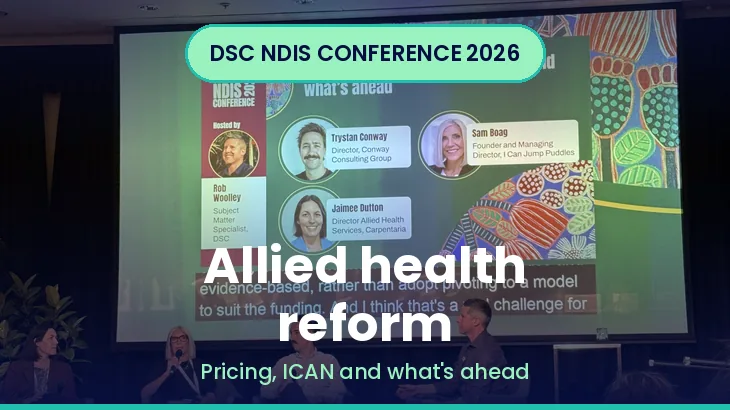
After a decade of near-unstoppable growth, allied health in the NDIS is heading somewhere very different, and this panel was refreshingly clear-eyed about it. Hosted by Rob Woolley, it brought together Trystan Conway of Conway Consulting Group, Sam Boag of the early-childhood provider I Can Jump Puddles, and Jaimee Dutton, a speech pathologist and allied health leader with deep rural and remote experience at Carpentaria. The message was blunt but ultimately optimistic: the market is changing whether you like it or not, and the providers who plan for it can come out stronger.
The market is about to look very different
For years, Trystan noted, allied health has had more demand than supply, which made it easy to grow. That era is ending. The NDIS bill points to an average of around 69 hours in therapy plans, and that number is almost certainly going to fall, along with the number of participants on the scheme. The result will be consolidation: providers who got in simply to make easy money will struggle, while high-quality providers actually have room to thrive. As he put it, the aim is to be bold when others are fearful, and to plan rather than react.
[Clickability update, October 2026: This is an attributed panel estimate, not a universal therapy allocation or a rule determining an individual plan. Do not infer your funded hours from it.]
Service models have to change
Sam argued that a reliance on one-on-one, session-based therapy is likely to become a thing of the past. It will not vanish, but the future is more collaborative and consultative, especially in early intervention: coaching and upskilling the educators and families in the places where children live, learn and play, rather than only working one-to-one with a child. The goal is capacity-building and inclusive communities, and those principles apply across the lifespan.
Trystan made the practical version of the point. The old home-visit economics, 30 minutes of travel each way around a one-hour session, will not be funded at the scale it is now, so innovative delivery models are an opportunity, as are acquisitions of the many inefficient or distressed businesses that consolidation will produce. His framing: you can double down or diversify. Doubling down is fine if you own it and become genuinely the provider of choice in your area, embedded in your community, your schools and your local early-childhood services, in which case referrals will never dry up.
Relationships are the real currency
Both Trystan and Jaimee kept returning to relationships. Trystan called the NDIS a relationship-driven industry, recalling a former business that got a hundred referrals a week despite a poor website, purely on nurtured relationships. With support coordination itself facing change, he urged providers to widen their referral networks beyond a few support coordinators, to commissioned not-for-profits, schools, early-childhood services and GPs, and to manage relationships in three tiers: your active referrers first (easiest to get more from), then warm leads who have referred before, then cold outreach to new referrers.
Jaimee brought the rural and remote lens, where relationships are not optional. In very remote Aboriginal communities, without trust you simply will not deliver a service; people will tell you to come back later. Sustainability there depends on building community relationships, leveraging other local services so support continues between fly-in visits, looking after FIFO staff, cultural responsiveness, and strong clinical supervision and reflective practice. She also flagged that last year's cut to travel funding has had big implications for remote provision, pushing providers to diversify into schools, aged care and training to stay viable.
Evidence-based practice as organisational DNA
A strong theme was anchoring your business in a best-practice, evidence-based framework, even when funding does not perfectly align with it. Sam was candid that at I Can Jump Puddles they have stayed true to what the evidence says rather than pivoting to suit the funding, pointing to the newly reviewed National Best Practice Framework for Early Childhood Intervention and its 14 principles (human-rights-based, person-centred, culturally appropriate, neuroaffirming, and more). Sticking to that, he said, is what wins tenders and opens collaborations with large not-for-profits, even for a small provider without a team of tender writers, because those partners want to see outcomes that match the evidence.
[Clickability update, October 2026: The Australian Government’s framework resources provide practice guidance for the 14 early-childhood intervention principles. A framework reference does not establish eligibility, commissioning or a guaranteed outcome.]
Trystan connected this to a shift from "push" to "pull." With capacity no longer scarce, demonstrating quality outcomes will matter: good outcomes, brand and reputation bring higher-quality referrals to you, rather than you chasing them. And he named governance as allied health's neglected space. Because registration has not been mandatory, many providers have got away with weak governance, but anyone wanting to be commissioned or to subcontract will need it. His changed advice: whereas two years ago he told allied health providers not to bother registering yet, he now thinks it is well worth doing, as a mark of the governance that sets you apart, and because it will be mandatory eventually.
[Clickability update, October 2026: Requirements vary by service and funding arrangement. Current mandatory registration guidance identifies specified services and transition arrangements; this panel prediction does not establish a universal allied-health commencement date.]
What this means for allied health providers
The practical to-do list from the panel: have a strategy and model multiple scenarios rather than waiting and seeing; get registered and build proper governance now; adopt an evidence-based best-practice framework as your organisation's DNA; rethink delivery away from one-to-one towards capacity-building; and widen your referral relationships well beyond support coordinators. Trystan's tip for anyone short of referrals: look an hour or two outside the capital cities, where demand is high.
What this means for multi-service and larger providers
Providers who run allied health alongside SIL, Day Options and other supports have an advantage in a commissioning market, and can offer in-house specialist support to their own SIL houses and staff. Alternative and direct commissioning is growing, and larger not-for-profits are well placed to win it, so partnerships and cross-system collaboration are worth pursuing now.
What this means for support coordinators, LACs and intermediaries
With therapy hours and participant numbers set to tighten, and single-stream allied health providers facing a harder road, knowing which providers have the governance, outcomes and multi-service depth to weather the change helps you connect participants to sustainable support.
What this means for participants and families
Therapy is likely to look different: more coaching of the people around a person and less one-to-one time, and possibly fewer hours. The panel's throughline is that quality and outcomes should matter more, not less, so it is fair to ask providers how they measure outcomes and what evidence base they work to.
The closing sentence the panel completed said it all. The allied health providers thriving in five years will be the ones who have a plan rather than waiting to see, who collaborate across systems, and who genuinely know their communities and what those communities need.
Meet the speakers
Trystan Conway, Director, Conway Consulting GroupLinkedIn Trystan advises allied health and disability organisations on finances and service models, drawing on experience building a provider to some 300 clinicians and $15 million in revenue.
Sam Boag, Founder and Managing Director, I Can Jump Puddles Sam leads the South Australian early-childhood provider I Can Jump Puddles, with more than 30 years in early childhood, and is an I-CAN assessor involved in the agency's quality therapy support work.
Jaimee Dutton, allied health leader, Carpentaria Jaimee is a speech pathologist and allied health leader with more than a decade delivering rural and remote services across the Northern Territory, with a focus on culturally safe care and health equity.
Rob Woolley (host) Rob hosted the session and works with DSC on allied health and NDIS practice.
A note on this series: this is Clickability's plain-English summary of a session at the DSC Annual NDIS Conference 2026, based on what was said on the day (13 August 2026). It reflects our interpretation and is not the official position of DSC, the speakers or the NDIA, and it is not NDIS or employment advice.
Clickability editorial update: October 2026
Plan scenarios while keeping participant needs and evidence central
Separate enacted requirements from consultation proposals and panel forecasts. Model costs and service options using your actual workforce, geography and participant needs. Do not reduce one-to-one care simply because a conference forecast suggests a different future model.
Use the relevant practice framework within its intended scope, agree changes with participants and document why the proposed arrangement suits them. Referral relationships should not replace transparent choice or appropriate governance.
Ask how a proposed therapy change applies to your own needs
Ask what is changing, why it is clinically appropriate and how outcomes and feedback will be reviewed. A sector forecast does not by itself change your plan or remove your right to discuss service choices. Seek an explanation of options and costs before agreeing.
Questions readers ask
Does the panel forecast determine my therapy hours?
No. Your actual plan and applicable rules determine funding.
Does the article establish a universal allied-health registration deadline?
No. Check current official service-specific requirements. Official guidance
Find therapy services to discuss your goals and options
Describe the disability service you want through Clickability. Compare reviewed and rated profiles and ask about suitability, evidence, access and communication.