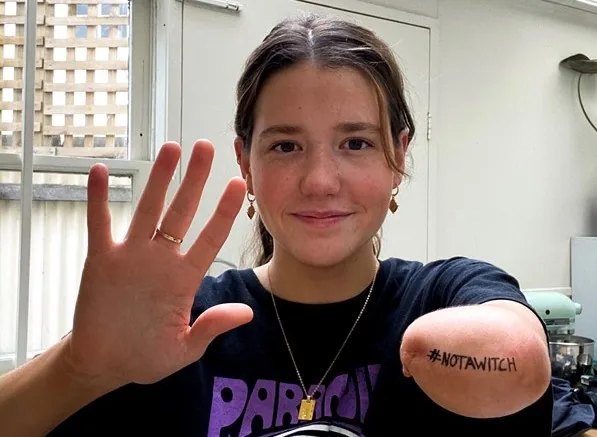
Disability representation: Isabella’s response to The Witches
Not a Witch: Disability is not scary.
By Isabella · Originally published 11 November 2020
Original article
I’m an Arts student with a deep love of Literature and French. I was born as a Congenital Amputee and have always aspired to work in Disability Advocacy. I’m about to start my Law Degree and can’t wait to become more engaged with the world of Law. I'm also part of the Clicka team!
2 years ago while at work a young girl, probably 8 or 9 years old, saw my amputation and ran away from me in tears. She told her Dad that she was afraid of the ‘lady with the scary arm.’ I was shocked and saddened both for myself and for that girl. For me, because I still struggle to love my differences and the way I look. For the girl, because she is growing up in a world that treats disability and physical differences as something to be feared.
Historically, disability has been seen as an issue to be eradicated, and in 2020 we are still fighting to overcome this belief. When I was growing up I never saw disabled men or women represented as beautiful or worthy in the media. I grew up being told by the world around me that disability and amputation was something to be ashamed of, to hide away.
In light of the release of the Witches movie, I wonder how we can expect our society’s ill-informed and unjust perception of disability to change? Roald Dahl’s film should be a cause for excitement, and instead it has been a slap in the face for people with limb differences all over the world. WB has unacceptably chosen to portray Anne Hathaway's character with hands that are reminiscent of the hands of many incredible and strong people in the limb difference community.
Limb difference is not deserving of fear.
Disability is not scary.
Our differences are not deformities.
It has taken me years of hard work to reach a place where I accept my lopsided body. With persistence and with the love of my family I have learnt to stop hiding myself and my arm away. Now, I meet the gaze of people who stare at me in the streets with a smile. I explain my difference to anyone who asks, presenting it as a form of diversity worth celebrating.
[Clickability update, September 2026: This is Isabella’s personal choice, not a duty for people with disability to educate strangers or answer questions about their bodies. Respect each person’s boundaries and preferred language. Read the respect and rights expectations.]
As Amputees and people with Limb Differences, we deserve to have our bodies and our beauty affirmed by not only our families, but by the broader community. Positive representation is so central to self love and a sense of worth. People with disabilities are intelligent, funny, beautiful and creative. It’s time Hollywood started showing it.
I can only imagine the pain and confusion that children with Limb Differences must be feeling at seeing their bodies presented as grotesque in Witches. I cannot begin to guess the fear parents of kids with Limb Differences must be feeling for the future of their children growing up in a world where Hollywood demonises disability. It breaks my heart and I will not stand for it. #notawitch
Clickability editorial update: September 2026
What participants can decide when someone asks about their body
You can choose whether to explain, redirect the conversation or decline. Prepare a response that feels comfortable if it helps, and ask a support person to follow your lead rather than answer for you.
The author’s decision to engage with questions is hers. Your comfort and privacy do not depend on being a role model or changing every person’s view.
How providers can review the images and stories they publish
Check whether a person is presented as a whole individual rather than a symbol of fear, pity or inspiration. Ask permission for the use, context and wording of a personal story, and make it clear how the person can raise concerns.
Does the article require people to answer strangers’ questions?
No. Isabella describes her own response; other people can set different boundaries.
Are the author’s student and work details current?
They belong to the 2020 article and have not been verified as current biography.
Find providers who respect your choices and boundaries
Describe the support and communication you want through Clickability. Read provider profiles, ratings and reviews, then discuss how your preferences will be respected.