Inclusive governance: hear people with intellectual disability directly
Nothing about us without us: why intellectual disability is still missing from the boardroom
By Clickability · Originally published 19 August 2026
Original article and dated context
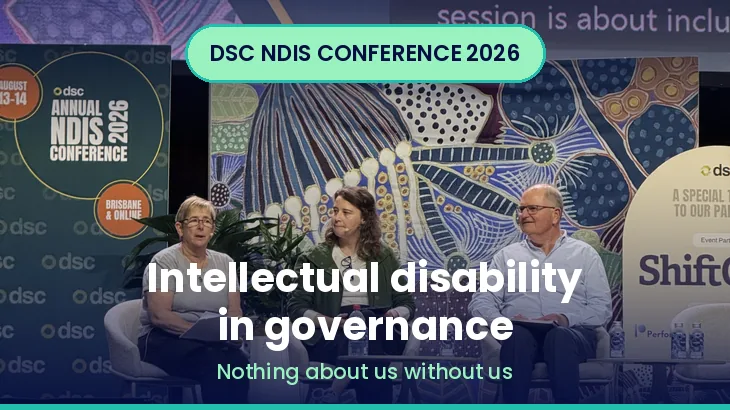
The disability sector has long championed "nothing about us without us," but this panel put a sharp question to the room: when it comes to governance, is that principle actually reaching people with intellectual disability, or are their voices being drowned out? Framed by Emeritus Professor Christine Bigby, with governance expert Dr Alan Hough and Inclusion Australia CEO Maeve Kennedy, plus a video from The Disability Trust, it was one of the more quietly challenging sessions of the day.
The uncomfortable numbers
Christine Bigby set the scene with research she and Alan Hough conducted in 2025, looking at 24 of the largest disability service providers. Just over half had a person with disability on their board. Only one had a director with an intellectual disability, despite the fact that people with intellectual disability make up the bulk of those they support. She noted the NDIA's own board has no one with intellectual disability either, even though adults with intellectual disability are the largest and costliest group using the scheme.
[Clickability update, October 2026: These are findings attributed to a particular 2025 sample. Do not present the sole-director description or the NDIA board comparison as verified current national membership.]
By contrast, inclusive governance is alive and well in smaller advocacy and self-advocacy organisations, like the Council for Intellectual Disability and Inclusion Australia, which have a high proportion of people with intellectual disability on their boards. Her pointed observation: while directors with other kinds of disability bring valuable lived experience of disability and discrimination, they cannot speak to the specific lived experience of intellectual disability any more than a non-disabled person can. That perspective has to be heard directly.
This echoes a finding from earlier in the day, where the DSC and Ability Roundtable benchmark put disability representation on provider boards at around 13% on average, with most participating organisations having at least one director with disability. The governance panel's point sharpens that picture: representation is growing, but intellectual disability specifically is still largely missing.
Is it just attitudes? Not quite
Asked why progress among service providers has been so slow, Christine resisted the easy answer that it is "just about changing attitudes." She and Alan, through the Australian Society for Intellectual Disability and Inclusion Australia, have sought legal opinions on whether there are genuine legal obstacles to having directors with intellectual disability on boards, and what corporations-law reform might be needed. Two opinions now exist, with complex arguments about possible barriers. She was careful to stress that a legal opinion is an expert's interpretation, not a definitive position, since only a court can settle the law. Organisations that want to dig in can find one opinion, alongside a position statement supporting inclusive governance, on the ASID website, and another on the VALID website.
[Clickability update, October 2026: ASID publishes a position statement, accessible summaries and a legal opinion raising substantial director-duty concerns. Read the plain-English legal summary. Its analysis is not a ruling that determines an individual appointment. Obtain advice for the actual governance structure.]
What it looks like in practice: The Disability Trust
The panel showed a video from The Disability Trust, whose board includes Andrew Radford, believed to be the only person with an intellectual disability on the board of a large provider. Andrew, a long-time advocate, joined because he believes strongly in "nothing about us without us." Board chair Peter Langkamp explained the deliberate goal of building a board that reflects the organisation's client base, and described the practical adjustments that made it work, including creating easy-read versions of board papers and breaking information into smaller pieces. Far from slowing things down, he said, it enhances the board's decision-making.
Why it makes governance better
Maeve Kennedy made the case plainly: inclusive governance is better governance. Boards make better decisions when they include the people affected by those decisions and can see the full picture, and for a service provider that means understanding the service experience, which you cannot bring unless you have used the service. Inclusion Australia builds both lived experience of intellectual disability and lived experience as a family member into its board skills matrix, treating them as genuine skills the organisation needs. It is also, she noted, a human rights issue: under the Convention on the Rights of Persons with Disabilities, people with disability have the right to participate in public life on an equal basis, with the support and access to do so.
It is bigger than one board seat
Alan Hough's contribution was the most practical. Governance, he reminded everyone, is a whole-of-organisation concept, not just the board. He urged organisations to start at the individual level, which he considers most important, with services that are genuinely person-led, not just person-centred on paper, understanding what matters to and for each person as an ongoing, dynamic process.
At the organisational level, he outlined six strategies, most of which carry no legal barriers at all: board advisers (influential, but careful they don't become "shadow directors" and take on directors' liabilities); board advisory committees (which, despite Royal Commission caution, many providers report working well, especially with independent chairing, a direct line to the board and CEO, and transparency about what happens to the advice); open town-hall meetings for everyone a provider supports; panels of advisers for detailed co-design; focus groups; and paid roles such as co-trainers and quality checkers. Whatever the approach, he stressed investing to make it succeed: plain-English papers provided well in advance, support people available before, during and after meetings, an appropriate pace, a supportive environment, and, crucially, paying people for their time and expertise.
Christine added one more strategy: building long-term individual relationships, since not everyone engages well in groups. If every board member had an ongoing relationship with one of the people their organisation supports, meeting regularly, boards would understand the real issues far better. Her challenge: board members need to leave the boardroom and get into the field.
Maeve closed on honesty. Inclusion is a journey, not a destination, and it has to be genuine rather than tokenistic; a person sitting in a meeting without being asked their view or given support to participate is not inclusion. She pointed to Self Advocacy Sydney, which has had directors with intellectual disability for more than 40 years, and shared practical techniques Inclusion Australia uses: accessible papers with time to prepare, prompts and recaps after each agenda item, working through questions beforehand, and a co-designed board inclusion statement led by a paid governance inclusion adviser. It takes ongoing commitment, time and resourcing, and, like so much of the day's themes, it is never set and forget.
What this means for providers and boards
If your organisation supports people with intellectual disability, ask honestly whether their perspective reaches your board, and not only through directors with other kinds of disability. You do not have to start with a board seat: advisory committees, panels, town halls, focus groups and paid quality-checker roles are all available now, most with no legal barrier. Whatever you choose, resource it properly, use plain English, and pay people for their expertise.
What this means for participants, families and self-advocates
Your perspective is a genuine expertise that boards need, and there is a growing toolkit of ways to contribute, from advisory committees to paid roles, that should be properly supported and paid. The principle holds: nothing about us without us, at every level.
What this means for support coordinators and advocacy organisations
Knowing which providers genuinely embed the voice of people with intellectual disability, and how, is a useful signal of quality. The legal opinions and position statements from ASID and VALID are practical resources to point boards toward.
Meet the speakers
Emeritus Professor Christine Bigby AO (host)LinkedIn Christine is a leading researcher whose work has shaped disability practice and policy for decades, with a particular focus on inclusion, equality supports and the experiences of people with intellectual disability, based at La Trobe University.
Dr Alan Hough Alan is one of the sector's most trusted experts on provider governance, working through his consultancy, Purpose At Work (purposeatwork.com.au), and as an adjunct professor at the La Trobe Living with Disability Research Centre.
Maeve Kennedy, CEO, Inclusion AustraliaLinkedIn Maeve leads Inclusion Australia, the national representative body for people with intellectual disability and their families.
Andrew Radford, board member, The Disability Trust A long-standing disability advocate and, believed to be, the only person with an intellectual disability on the board of a large disability provider.
Peter Langkamp, Chair, The Disability Trust Chair of The Disability Trust board, which has deliberately built its membership to reflect the organisation's client base.
A note on this series: this is Clickability's plain-English summary of a session at the DSC Annual NDIS Conference 2026, based on what was said on the day (13 August 2026). It reflects our interpretation and is not the official position of DSC, Inclusion Australia, The Disability Trust, the speakers or the NDIA, and it is not legal or governance advice.
Clickability editorial update: October 2026
How boards can test whether participation changes decisions
Choose a real decision and identify whose experience is missing. Provide accessible information in advance, allow preparation and support, and explain how advice reaches decision-makers. Budget for people’s time and report what changed after their contribution.
Do not assume an advisory role and a director role have identical responsibilities. ASID’s legal resources and position statement explain the concerns and advocacy context. Review responsibilities and support with advice suited to your organisation.
What participants can ask before joining a governance activity
Ask what the role can influence, what you will need to read and how preparation, communication and payment work. Find out who supports you if something is unclear and how you can see what happened to your advice. You can ask for a different way to contribute without accepting a role you do not want.
Questions readers ask
Does a legal opinion settle every appointment?
No. It analyses the law and risks; an organisation needs advice about its own circumstances. Official guidance
Is attending a meeting enough to show meaningful inclusion?
No. Check whether the person can prepare, contribute and see how their input affects decisions.
Find providers who will explain how your voice is heard
When choosing support, ask how participants influence the service and raise concerns. Use Clickability’s profiles and reviews to prepare a shortlist and those questions.