Employment for people with intellectual disability: meaningful jobs and support
Expanding employment for people with intellectual disability: what actually works
By Clickability · Originally published 19 August 2026
Deeper review: 6 October 2026. The deeper review adds article-specific decisions and audience guidance. Historical passages and their adjacent corrections remain preserved.
Original article and dated context
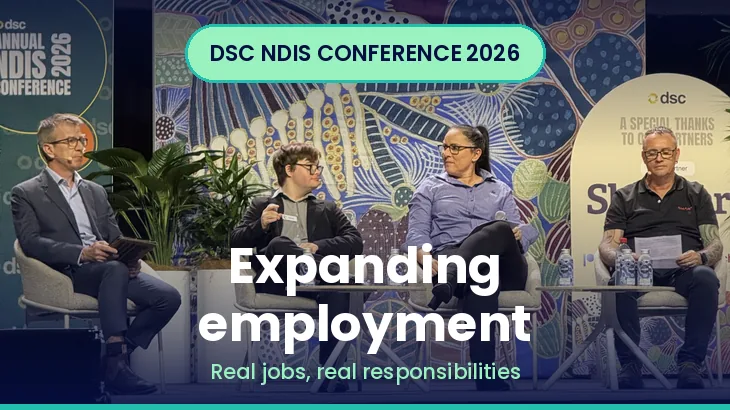
If the disability sector can't lead the way in employing people with intellectual disability, it's asking a lot to expect everyone else to. That was the challenge at the heart of this warm, practical panel, hosted by Down Syndrome Australia CEO Darryl Steff, and it landed because the people on stage were living the answer.
The starting numbers are stark. Fewer than 30% of NDIS participants with intellectual disability are in paid employment, and most of those who are work in segregated settings. Behind the statistics, as the panel put it, are thousands of people with skills, talents and aspirations who want the same opportunities most of us take for granted. The good news, the panel argued, is that we already know what works.
[Clickability update, October 2026: This statistic and the description of segregated work are conference claims. The source does not supply the reporting period and dataset needed to reuse them as current 2026 population figures.]
Meaningful employment is the same for everyone
Jeremy Cooke, who works front of house at Carina Leagues Club greeting members and helping at events, described why he loves his job in terms anyone would recognise: meeting new people, being trusted, and being able to be himself. As Liz Christodoulou of Down Syndrome Australia put it, people with intellectual disability are looking for exactly what everyone looks for in work, a fair wage, real choice, and a job that is meaningful rather than a task invented to keep them busy. She contrasted Jeremy's current role with an earlier job that was just stamping coffee cups, which did nothing for his life. Meaningful work enhances a person's life and builds on what they can do.
From an employer's seat, Anthony Barnes of Capital SMART framed it the same way: meaningful employment is a genuine opportunity to contribute and succeed, not a role created to tick a box or hit a target. It is about finding where a person's strengths add value to the business, so they grow in confidence and their teammates see them as just another valued team member.
The misconceptions holding employers back
Liz named the usual fears head-on: employers assume it will be too hard, too expensive, and require too much change. The reality, she said, is very different. The key is matching the right person to the right job, and recognising that the barrier is usually not a person's disability but the way recruitment has been designed. Fix the recruitment process, educate the workplace, and change follows. Most people with intellectual disability who get work won't get it by applying on a job board; it takes a more personal, targeted approach, and when that happens, it works.
One employer's story
The most persuasive part of the session was Anthony's account of hiring Hunter, who joined Capital SMART's Queensland workshop through a partnership with Down Syndrome Queensland. His honest worry going in was whether they'd get the support right and set Hunter up to succeed rather than fail. What actually happened was the opposite of what he feared. Success wasn't about lowering expectations; it was about clear instructions, consistency and support. They started Hunter gradually with a simple weekly routine sorting stock, built his confidence, and he now strips second-hand doors and tailgates, genuinely speeding up a busy workshop that turns over 25 vehicles a day.
Two things stood out in Anthony's telling. First, the impact on the whole team: his staff became more patient, more supportive and more aware of each other's strengths, and the site's culture grew stronger than he expected. Hunter has a nickname for everyone and is greeted with a booming "Big Dog" across the workshop, and his teammates now pick him up on weekends for the movies or golf, a reminder that inclusion at work leads to inclusion in the community. Second, Anthony refused to treat it as charity. He turned down an incentive to take Hunter on; Hunter is a trade assistant paid the same as every other trade assistant on the floor, because people want real jobs with real responsibilities and real expectations.
What makes it work, and what doesn't
Liz explained how Down Syndrome Australia's Employment Connections program supports both sides end to end: getting to know the jobseeker's skills and strengths, training the workplace on what Down syndrome and intellectual disability actually mean, supporting a successful transition, and staying involved with ongoing support rather than placing someone and walking away. The program has placed more than 150 people, and often brings an Employment Ambassador with lived experience so employers can ask the hard, curly questions safely. Her point: we spend a lot of energy teaching people with disability how to get a job, but not enough educating the workplaces that would employ them.
On what doesn't work, the panel was blunt. Tokenism and hiring to tick a box fail. Not educating the whole staff group fails. Focusing on the disability instead of the individual fails, because if you assume someone can't do something, you never find out what they can. Treating it as charity fails. And leaving it to a single manager fails; for Capital SMART, it worked because the whole team, and upper management, were behind it.
What this means for providers and employers
The sharpest message was aimed squarely at the sector: think of people with disability as employees, not only as clients. If you run a disability service, you are also an employer who can lead by example. Start with an open mind, partner with a specialist employment service, design around strengths, involve the whole team, and pay people properly for real work.
What this means for participants, jobseekers and families
The panel's message to jobseekers and families was one of encouragement: meaningful, properly paid work is your right, not a favour, and the right job match makes all the difference. Services like Down Syndrome Australia's Employment Connections exist in every state and territory to support both you and an employer.
[Clickability update, October 2026: Confirm the named program’s current coverage and availability directly. NDIS employment supports, Inclusive Employment Australia and employer adjustments have different responsibilities. Use the NDIA employment guide.]
What this means for support coordinators, LACs and intermediaries
Employment is a goal worth actively pursuing in planning conversations. Connecting participants to specialist employment programs, and encouraging a personalised, strengths-based job match rather than a generic job search, is where you can shift outcomes.
The panel's closing asks summed up the spirit of it. Anthony: give someone an opportunity and don't let uncertainty stop you. Liz: stop waiting until you feel completely ready, look around your own organisation next week, and reach out. And Jeremy, given the last word, kept it simple: have confidence, be brave, be who you are, and be honest.
Meet the speakers
Jeremy Cooke, Foyer Attendant, Carina Leagues Club A valued front-of-house team member at Carina Leagues Club, known for the warm welcome he gives members and guests, and a self-advocate for the value of real, meaningful work.
Liz Christodoulou, National Employment Program Manager, Down Syndrome Australia Liz leads Down Syndrome Australia's employment work, including the Employment Connections program, partnering with employers across the country to create and sustain inclusive jobs.
Anthony Barnes, Queensland Operations Manager, Capital SMART Anthony leads Capital SMART's Queensland operations and champions inclusive employment in the automotive industry, having built inclusive roles into his workshops.
Darryl Steff, CEO, Down Syndrome Australia (host) Darryl is Chief Executive of Down Syndrome Australia and a national advocate for the rights and inclusion of people with Down syndrome.
Read the full 2027 NDIS changes summary from the reforms reshaping the NDIS to who's expected to stay or go and the crackdown on unscrupulous providers, we've pulled every hot topic and its likely outcome into one quick overview, then gone deeper on each with its own explainer written for both providers and participants, Q&A included. Get the lot in the DSC NDIS Conference 2026 wrap-up.
A note on this series: this is Clickability's plain-English summary of a session at the DSC Annual NDIS Conference 2026, based on what was said on the day (13 August 2026). It reflects our interpretation and is not the official position of DSC, Down Syndrome Australia, Capital SMART, the speakers or the NDIA, and it is not NDIS or employment advice.
Turn a work goal into a job and support plan
Start with the job you want to try
Describe the tasks, setting and hours that interest you. Ask to visit or try an appropriate opportunity and discuss the support that would make it workable. A service should help you explore real choices rather than assume your diagnosis determines the job or workplace.
Ask who employs you, what you will be paid, what the duties are and who helps when something changes. The conference stories show individual experiences; they do not promise the same job or outcome for everyone.
Ask who you can contact if the job is not working for you.
Build the role and explain who does what
Identify useful work, clear instructions, suitable supervision and accessible recruitment. Ordinary employer responsibilities and reasonable adjustments are separate from NDIS-funded disability support. Do not charge the participant’s plan for wages or routine employer obligations. Read the official guidance
Include the worker in reviewing duties and support. Discuss agreed changes with the person rather than only with a family member or coach. If an employment service is involved, make responsibility for workplace training and ongoing support clear.
Join the mainstream and NDIS support without duplication
Inclusive Employment Australia replaced Disability Employment Services on 1 November 2025. Check the current program and the person’s eligibility rather than relying on an older DES reference. Read the official guidance
NDIA’s current employment-provider guidance calls for a joint plan when NDIS and employment-program providers work together. Record who finds opportunities, supports the workplace and provides additional disability-related assistance. Review the jobseeker’s experience and progress instead of counting attendance at a programme as a job outcome. Read the official guidance
Questions readers ask
Are the panel’s job examples guarantees of employment?
No. They describe individual experiences and approaches.
Are all employment supports paid from an NDIS plan?
No. The employer, outside employment services and NDIS have different roles. Official guidance
Is Disability Employment Services still the current programme name?
Inclusive Employment Australia replaced DES on 1 November 2025. Check the current programme and eligibility with the relevant employment service. Official guidance
Find support for your employment goals
Tell Clickability what assistance you need to prepare for or keep work. Compare employment-service profiles and reviews and ask how a provider will support the job you want.