NDIS Commission priorities: registration, enforcement and governance
The NDIS Commission on registration, enforcement and its next priorities
By Clickability · Originally published 23 August 2026
Original article and dated context
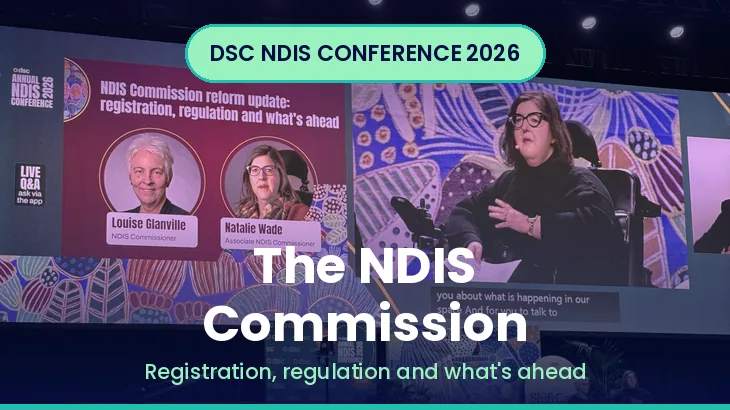
Following the NDIA's Scott McNaughton, the sector's regulator took the stage. Commissioner Louise Glanville and Associate Commissioner Natalie Wade chose to ditch the slides and simply talk, walking through where mandatory registration has landed, how the Commission is using its strengthened powers, and what it will be watching in the year ahead. The consistent theme was a regulator that describes itself as still maturing, leaning harder into compliance and enforcement while trying to work more openly with the sector.
A maturing regulator with sharper teeth
Glanville was frank that the Commission is still getting better at the regulatory task, and welcomed the additional powers government has granted. She pointed to recent new banning powers, used for the first time against an auditor and a consultant, something the Commission simply could not have done before. The framing was that these powers exist as a suite, to be matched to the risk, and that the Commission wants to be accountable for using them well while asking the sector to work with it in return. The approach is explicitly risk-based, concentrating effort where the most serious risks and the greatest impact lie.
She also stressed collaboration, noting she and Scott McNaughton go back to the NDIA's earliest years, and pointing to the Fraud Fusion Taskforce as one important channel for sharing data and intelligence. And she made a point often missed in safeguarding conversations: the Commission also cares about the safety of workers, meeting regularly with unions, because worker safety and participant safety go together.
Mandatory registration, and a first definition of SIL
Wade led on registration, now in what she called its third year of evolution. From 1 July this year, mandatory registration applies to supported independent living (SIL) and digital platform providers. That milestone gave the regulator its first real chance to define what SIL actually is: a package of home-and-living supports for people with higher support needs who require assistance most or all of the day. Crucially, it does not include situations where a person receives only a few hours of support, or independently chooses and manages their own workers.
The reason SIL was targeted first is risk: it is often delivered in group or closed settings where natural safeguards, advocacy and agency are weakest. Registration makes those providers visible to the Commission for the first time and brings practice standards to bear. Early data shows the market responding: some providers have left, many new ones have registered, and some who had signed up to deliver SIL turned out not to be delivering it. Higher-risk supports become subject to mandatory registration from 1 July 2027, and the Commission will consult on the scope of that next.
[Clickability update, October 2026: This is the reported conference direction, not a settled rule applying to every higher-risk service. Scope and commencement depend on final policy and rules. Check current mandatory-registration guidance.]
A standout point: when SIL practice standards were redesigned, it was done alongside people with disability and Inclusion Australia, and for the first time in the history of Australian service delivery there is now a requirement for supported decision-making. Both commissioners were visibly proud of that.
Enforcement is real
Glanville did not soften the enforcement message. Referencing the tragic example Scott McNaughton had shared, she said plainly that she and Wade are tired of people dying from the services they receive, rare, but common enough to worry about constantly. As a marker, she cited a record $2.5 million penalty against Lifestyle Solutions last November, for admitted contraventions of the NDIS Act and more than 1,800 breaches of the reportable incidents rules, the highest penalty a court has imposed. Her point was not to spread fear but to signal the powers exist and will be used where needed. The Integrity and Safeguarding Amendment Bill, which received assent in April, adds stronger civil and criminal penalties to that toolkit.
[Clickability update, October 2026: The Commission’s historical announcement confirms the penalty and 1,811 reportable-incident-rule contraventions. Read the enforcement announcement. A reported penalty is not a prediction about another case.]
She also flagged a data and regulatory transformation, funded by government, that will move the Commission away from heavily manual work, improve efficiency, and, importantly for providers, deliver a new portal that shares more of the Commission's data back to the sector.
The 2026-27 regulatory priorities
Wade closed the presentation with three priorities for the year ahead: providers implementing restrictive practices while not registered to do so; exploitative, coercive and dishonest behaviour that puts participants at risk; and, notably, governance failures affecting quality and safety in high-risk settings. That last one signals the Commission looking beyond frontline practice to the boardroom.
What this means for providers
The direction is unambiguous: more visibility, more enforcement and a sharper eye on governance. If you deliver SIL or platform services, registration and the redesigned practice standards (including supported decision-making) now apply. From July 2027, higher-risk supports join them. Get your governance in order, because it is an explicit priority, and expect the Commission to share more data with you via the new portal. Glanville's repeated offer to reward quality through pricing is worth holding them to.
[Clickability update, October 2026: Registration applies to the defined services and relevant transition pathway, not every home support or website. The SIL guidance addresses the 1 October 2026 application boundary. Check your actual SIL pathway now.]
What this means for participants and families
The reforms are ultimately about your safety and rights. The new supported decision-making requirement means providers must actively support your choices, and Glanville made a strong case that real safeguarding comes not just from being connected to community but being genuinely included in it. If you experience poor or unsafe service, from any provider, the Commission wants to hear about it.
What this means for support coordinators and intermediaries
One myth was busted directly: the Commission does have jurisdiction over unregistered providers, through the Code of Conduct, so report them. The Commission acknowledged it has not always acted visibly on such reports and committed to a more sophisticated, risk-based approach with more investigations and more transparency about what it does with the intelligence you provide.
Q&A
Any update on the timeline for new mandatory registration? SIL and platform providers are in their transition period now, picked up through the audit cycle; those not yet registered should sign up. Information on higher-risk supports (from July 2027) will follow once the policy settings are right.
Progress on mandatory registration for self-directed supports? A big, new area the Commission is working through with the Department and the agency, with significant community and sector engagement planned. The guiding concern is not disrupting people's existing services.
Will the Commission build sector capacity to help frontline workers support community connection? Glanville sees connection and inclusion as the most solid form of safeguarding, and pointed to recent safeguarding workshops with states, territories and the NDIA, with more formal work on inclusion and "community safeguarding" to come.
Providers report unscrupulous (often unregistered) providers but are told it's out of scope. What should they do? Wade was clear the Commission can regulate unregistered providers via the Code of Conduct, so report them. As it shifts to a risk-based model, expect more visible responses, more investigations and more compliance action, though not every single matter will be individually investigated. Glanville added that the Commission needs to explain its work far better and be more transparent, and that some delays are genuinely due to multi-agency matters.
Meet the speakers
Louise Glanville, NDIS Quality and Safeguards Commissioner Louise leads the NDIS Commission, the national regulator of NDIS services, with a long background in law, legal assistance and public administration.
Natalie Wade, Associate NDIS Quality and Safeguards Commissioner Natalie is a disability rights lawyer and Associate Commissioner, with deep expertise in disability law and the rights of people with disability; she will act as Commissioner during Louise's upcoming leave.
Read the full picture: from the reforms reshaping the NDIS to who's expected to stay or go and the crackdown on unscrupulous providers, we've pulled every hot topic and its likely outcome into one quick overview, then gone deeper on each with its own explainer written for both providers and participants, Q&A included. Get the lot in the DSC NDIS Conference 2026 wrap-up.
A note on this series: this is Clickability's plain-English summary of a session at the DSC Annual NDIS Conference 2026, based on what was said on the day (14 August 2026). It reflects our interpretation and is not the official position of the NDIS Commission, DSC, the speakers or the NDIS, and it is not legal or NDIS advice.
Clickability editorial update: October 2026
How providers can separate requirements from reform announcements
Check your actual service against the SIL or digital-platform definition, then follow the pathway for your registration status. Record responsibility for each action and verify current rules before relying on a conference timeline.
Map the three 2026–27 regulatory priorities to the risks in your service: restrictive practices, exploitative conduct and governance failures in high-risk settings. Check whether staff know how concerns are escalated and whether leaders follow up.
How participants can raise concerns about any NDIS provider
Ask who handles feedback and how you can receive an accessible response. The Commission’s Code of Conduct reaches registered and unregistered NDIS providers. Use the Commission’s reporting information if support is unsafe or poor; contact emergency services if there is immediate danger. Reporting does not guarantee a particular investigation or timetable.
Questions readers ask
Does every provider website count as an NDIS digital platform?
No. The definition includes specified intermediary and payment functions; use the official scope. Official guidance
Can the Commission receive concerns about unregistered providers?
Yes. The Code of Conduct applies to registered and unregistered NDIS providers. Official guidance
Find providers and ask clear safety questions
Describe the service you need through Clickability. Compare profiles, ratings and reviews, then confirm relevant registration, feedback processes and the support arrangement.