Inside the NDIA: the 2026 reform and safeguarding discussion
The NDIA's Scott McNaughton on reform, wait times and the fight against unscrupulous providers
By Clickability · Originally published 23 August 2026
Original article and dated context
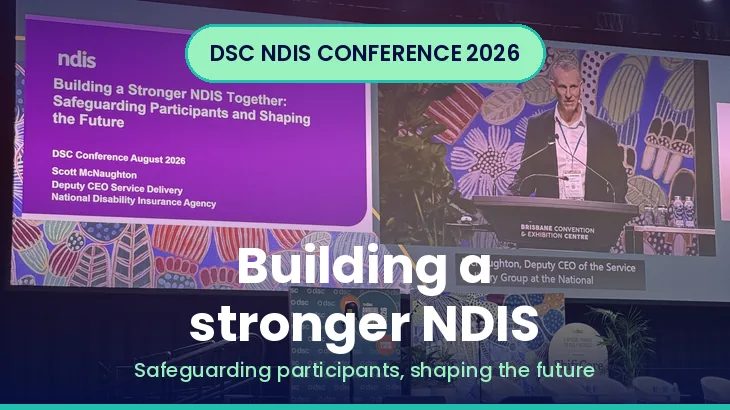
Day 2 opened with one of the people responsible for actually running the scheme. Scott McNaughton, Deputy CEO of the NDIA's Service Delivery Group, gave a frank account of where the agency has come from, what the big reforms mean in practice, and the part of his job that keeps him up at night. His central message: managing reform and running the scheme day to day are not competing priorities. The agency has to do both, and do both well.
A scheme still growing, and a "perfect storm" survived
The scale is striking. From the 2013 trials, the NDIS now supports more than 780,000 participants, spent $51.2 billion on participant supports last financial year, and still sees around 2,000 people a week come forward for access. Growth ran at about 10.5% last year; the Minister has signalled an expectation closer to 5 to 6%, moderating over time.
McNaughton was candid about a hard recent stretch. Around two years ago the agency rolled out a major new IT system (PACE), at the same time as the 2024 legislative changes landed and growth ran well above forecast. The result was a "perfect storm": at the peak, roughly 50,000 plan-change requests and 30,000 access requests on hand, with people waiting an average of about 100 days for a plan change. He owned it plainly, and apologised for it.
The recovery is the good-news story. Over 18 months, backed by extra government investment and 600 new frontline staff, the agency is back to what he calls business as usual. About 96% of access and first-plan decisions are now made within its target timeframe, the plan-change wait has fallen from about 100 days to 16, and complaints are among the lowest in some time. He was emphatic that complaints matter: his group reads every one, asking whether a decision was wrong, right but poorly explained, or a symptom of a system or process problem. As he put it, if you cannot get business as usual back on track, it is very hard to do reform at all.
McNaughton walked through the reform agenda without speculating on the bill still before Parliament (the Senate Committee was reporting back that very day).
On Thriving Kids, he confirmed a progressive rollout from October, fully in place by January 2028, aimed at identifying children with additional developmental needs early and connecting them to high-impact supports. His most important point, and one he says parents ask about constantly: children with high support needs and significant permanent disabilities will still be part of the NDIS. The Department leads Thriving Kids; the agency's focus is giving families clear information through the transition.
He called new framework planning perhaps the most significant reform underway. The goal is a more equitable, consistent and transparent approach to budgets. Today's planning, he acknowledged, can be inconsistent: participants with similar needs can end up with very different budgets, partly driven by who can marshal more reports and evidence. He gave a memorable example of two 18-page reports handed to a planner that were identical except for mismatched names, apparently AI-generated, leaving the planner to somehow decide what was reasonable and necessary. The fix at the heart of new framework planning is a new support needs assessment, built on the I-CAN tool (purchased in partnership with the University of Melbourne) plus personal and environmental circumstances and targeted modules, delivered face to face or virtually by trained, accredited assessors. The agency is standing up a Support Needs Assessment Training Academy with TAFEs and universities, is out to market now, and aims to have it running by year's end. Around 700 to 800 "life tests" have been done so far, heading for 10,000 by the end of the year. New framework planning commences from April next year and rolls out progressively over three and a half to four years, with a phasing plan still to be signed off by government. A key principle is a return to longer plans, potentially two to five years.
On the bill itself, he noted it proposes changes to access (via the functional capacity work of the Technical Advisory Group we heard about on Day 1), planning, who can lodge unscheduled plan reassessments, and social and community participation funding, plus stronger fraud and integrity powers and market reforms including commissioning for high-risk services. Some changes would start quickly on royal assent; others are designed for 2027 and into 2028.
The improvements that aren't reform
McNaughton was keen to stress that the agency's day-to-day job matters just as much as reform. He pointed to expanding specialist pathways, now around 500 staff taking a case-management approach for participants with complex circumstances, including those interacting with aged care, justice, health and child protection systems, and people with degenerative or terminal conditions such as motor neurone disease, Huntington's and early-onset dementia, who get a dedicated rapid pathway because time matters. New child protection liaison officers are being piloted in WA and Victoria. He paid tribute to the remote community connector program (around 300 to 400 organisations covering 500 remote communities, with a specific shout-out to the Miwatj Health team who presented on Day 1) and flagged a national contact centre now handling about 60,000 calls and emails a week, brought back in-house from Serco with 500 staff so that "first contact resolution" is possible. A dedicated First Nations Connect phone line launched last month.
The part that keeps him up at night
The most powerful section was on participant safeguarding. McNaughton said the hardest thing that crosses his desk is evidence of unscrupulous providers exploiting the most vulnerable people in the country, and he did not hide that it affects him. He described a support coordinator offering clients $40,000 cash to switch, then siphoning their plans; and "Kylie" (not her real name), a young woman with complex disability moved out of her supported living without her family able to find her, whose health declined rapidly once the supports stopped. His participant safeguarding branch of around 200 staff works daily on these cases, intervening alongside the NDIS Commission, involving guardians, and sometimes physically returning people to safety. His call to the room: there are still far too many providers in the scheme for the wrong reasons, it can be solved, but only as a collective effort to identify risk early and act swiftly.
What this means for providers
Two practical signals. First, the agency believes it has its wait times and backlogs back under control, so the operating environment should be steadier, but new framework planning and support needs assessments are coming from April and will reshape how budgets are set. Second, the safeguarding crackdown is aimed squarely at bad actors, which is good news for reputable providers; expect more intervention, and commissioning for high-risk services on the horizon. McNaughton also acknowledged provider financial stress directly, pointing to market stewardship, price setting and quality pilots as the agency's levers.
[Clickability update, October 2026: The reassurance below was given before passage of the legislation. It is not a guarantee that every current setting remains unchanged today. Use current NDIA communication about the person’s plan and the staged Thriving Kids rollout.]
What this means for participants and families
The reassurance for families was explicit: children with high or permanent needs stay in the NDIS despite Thriving Kids. New support needs assessments are coming, longer plans are on the way, and McNaughton stressed that until government changes the law, existing access and planning settings remain the same. If you or someone you support has a degenerative or terminal condition, there is now a dedicated rapid pathway, and there is a new First Nations Connect line.
What this means for support coordinators and intermediaries
The safeguarding examples centred on intermediaries behaving badly, so expect scrutiny, and know the agency actively wants reports of risk. Commissioning changes for support coordination and high-risk services are being piloted and consulted on now.
Q&A
Do plans mostly go up or down? McNaughton said the data shows roughly 52% of plans go up each week, about 35% go down and the rest stay the same, with more value added than removed overall. Plans change as circumstances change, sometimes up for greater vulnerability, sometimes down as capacity is built. He stressed that until government changes policy or legislation, existing access and planning settings remain the same, which is the clear instruction to frontline staff.
How is the agency addressing provider sustainability, not just scheme sustainability? Through market stewardship and price setting with the Department, and through innovative quality pilots around SIL and support coordination exploring what good practice looks like. He said the sector does not need to get rich, but it does need to be vibrant and viable, and improving it is a joint effort.
Has "low to moderate needs" been defined, and if not, when? Not yet. It is something the Technical Advisory Group is working through, both what it means and how to test and measure it objectively. More is expected in coming months.
What skills and qualifications will I-CAN assessors need? Current assessors have an allied health background, but the University of Melbourne partners advise that people from other backgrounds can deliver the assessment with the right training and accreditation. The new academy will accredit assessors, with supervised practice and ongoing quality assurance.
Meet the speaker
Scott McNaughton, Deputy CEO, Service Delivery Group, NDIA Scott leads service delivery at the National Disability Insurance Agency, overseeing access, planning, the contact centre, specialist pathways and participant safeguarding.
Read the full 2027 NDIS changes summary from the reforms reshaping the NDIS to who's expected to stay or go and the crackdown on unscrupulous providers, we've pulled every hot topic and its likely outcome into one quick overview, then gone deeper on each with its own explainer written for both providers and participants, Q&A included. Get the lot in the DSC NDIS Conference 2026 wrap-up.
A note on this series: this is Clickability's plain-English summary of a session at the DSC Annual NDIS Conference 2026, based on what was said on the day (14 August 2026). It reflects our interpretation and is not the official position of the NDIA, DSC, the speaker or the NDIS, and it is not NDIS advice. Reform timelines depend on legislation and may change.
Clickability editorial update: October 2026
Follow up your own request rather than relying on an average
Keep a copy of what you sent, when it was received and any reference number. Ask what stage the request has reached and whether further information is needed. A conference average cannot promise the completion date of your access or plan-change request.
If the concern is service quality or safety, say that directly rather than presenting it only as a budget problem. The Commission’s complaints pathway is different from asking the NDIA to review a funding decision. Use the route that fits the issue, and retain a record of the response.
Respond to warning signs without relying on the case story
The described cases illustrate the seriousness of risk; they are not a checklist that captures every form of exploitation. Listen when a participant reports pressure to change providers, unclear use of funding or interruption of essential support. Record the facts, the immediate concern and the person’s preferences.
Distinguish a complaint about service delivery from suspected misuse of NDIS money. Follow NDIA fraud-reporting guidance for suspected fraud and Commission guidance for support-quality concerns. Do not investigate or publicise someone’s identity based on the article’s pseudonymous example.
Questions readers ask
Do the quoted waiting-time averages guarantee my request’s timing?
No. They describe the presentation’s account of performance at that time.
Is suspected fraud the same as a service complaint?
They can require different reporting pathways. Describe the issue and use the relevant guidance. Official guidance
Is the bill still awaiting passage?
No. The editorial update links the enacted legislation and current implementation guidance. Official guidance
Find a provider you can question and compare
Tell Clickability which services you need. Review profiles and participant feedback, then ask about communication, continuity and the way your funding will be used.