NDIS budget categories: use your plan to check spending
Your NDIS Budget Cheat Sheet: How to maximise your plan
By Jess · Originally published 5 August 2020

Deeper review: 6 October 2026. The deeper review adds article-specific decisions and audience guidance. Historical passages and their adjacent corrections remain preserved.
Use four labels to find the right question
The original three-bucket diagram is historical. Current guidance describes Core, Capacity Building, Capital and Recurring budgets. The budget type, support category and item code are different levels of information; the eligibility lists are another separate check. Read the official guidance
For a proposed purchase, write the item in everyday language first. Find the relevant wording in your plan, then ask about eligibility, restrictions and available funding. Starting with a code that has spare money can send the decision in the wrong direction.
For service options, compare plan manager against the tasks and communication you need.
Original article and dated context
Understanding the Structure of Funding
[Clickability update, September 2026: The original diagram shows the earlier three-budget framework. Current guidance also includes recurring supports. Read your actual plan’s budgets and restrictions.]
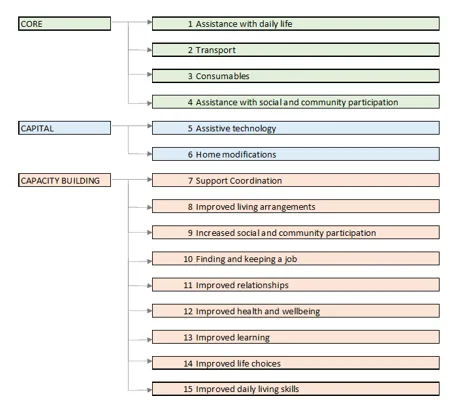
Text description of the historical funding diagram
The original diagram groups fifteen categories into three budgets. Core: assistance with daily life, transport, consumables, and assistance with social and community participation. Capital: assistive technology and home modifications. Capacity Building: support coordination, improved living arrangements, increased social and community participation, finding and keeping a job, improved relationships, improved health and wellbeing, improved learning, improved life choices, and improved daily living skills.
This is a transcription of the 2020 image, not the complete current framework. Current plans may also include recurring supports; check your actual plan and the adjacent currentness note.
- Is the item related to the goals identified in the participant’s NDIS plan?
- Does the participant have funding in the area where the item can be claimed from?
- Where should the item be claimed from to maximise the use of the plan? For example, with items that can be claimed from different line items, which item code should you claim it from. With these items, consider the remaining funding of the different buckets and the other supports you need to claim. Ensure that you have the necessary funds to claim for other necessary items. If you do not, it may be time to ask for a plan review!
[Clickability update, September 2026: Use the code that accurately describes the support and fits your plan. A larger balance elsewhere does not permit relabelling a claim or moving stated funding. See current budget guidance.]
The Way Funding is Managed
- Self-management
- Plan-managed funding
- NDIA (Agency) managed funding
- Mixed (of any of the above)
Self-management:
Plan Management:
[Clickability update, September 2026: Registration requirements apply to particular services even with plan-managed funding. Alongside specialist behaviour support, plan management and SDA, mandatory registration for defined supported independent living and NDIS digital platform providers began on 1 July 2026 with transition arrangements. Check the actual service definition and provider’s transition status. Read the Commission’s current registration requirements.]
NDIA / Agency managed
Mixed
What are the benefits of Plan Management?
Read a budget without confusing its different labels
Make a one-page spending map
With the participant’s permission, make columns for the support, budget wording, management method and remaining commitments. Add the next funding-release date where it applies. A mixed arrangement may have different claiming processes for different supports, so avoid assuming one manager handles everything.
Keep the map beside the actual plan and date each update. If a statement uses an unfamiliar label, ask for a plain-language explanation and record it. This helps another trusted person continue the administration without having to reconstruct every conversation.
Agree who checks reports and who contacts a provider about an invoice error.
A better code cannot make an excluded purchase eligible
Describe the actual service before selecting a claim item. Do not move an invoice to a different category merely because the first balance is low. Where wording is stated or quote-required, resolve that requirement before work or purchase.
Explain corrections clearly if an invoice used the wrong item. Keep any eligibility question separate from a mathematical budget forecast. A participant might have enough money for an item that cannot be funded, or an eligible support for which insufficient funding remains. Neither problem is solved by relabelling the charge.
Questions readers ask
Are the three buckets in the original picture the whole current framework?
No. Current NDIA guidance also describes recurring supports. Use the budgets and restrictions in your actual plan. Official guidance
Can I use a different code because that category has more money?
Not simply for that reason. The claim must accurately reflect the support and fit your plan and funding rules. Official guidance
Are support budgets, categories and item codes the same thing?
No. They describe different levels of the plan and claiming structure. Use the actual plan wording and the support rules together. Official guidance
Find a plan manager who makes your budget understandable
Explain the reporting format and support you want through Clickability. Compare rated and reviewed plan-management providers before choosing.
Find a provider for plan management · Browse plan management providers