NDIS cleaning and gardening: check the task, funding and quote
Making the NDIS Work for You: Gardening, Cleaning, and Home Maintenance
By Plan Partners · Originally published 23 May 2021
Deeper review: 6 October 2026. The deeper review adds article-specific decisions and audience guidance. Historical passages and their adjacent corrections remain preserved.
Turn a household task list into a usable quote
Start with the tasks your disability makes difficult, then describe the help you need with each one. “Clean the bathroom every fortnight” is clearer than “home maintenance”. Keep ordinary repairs and property improvements on a separate list; a provider calling work NDIS maintenance does not approve it. Read the official guidance
Ask which tasks fit one visit, who supplies equipment, what happens to green waste and which proposed costs are private. Agree how the provider will tell you if the job is larger than expected. A clear task description helps prevent a routine visit becoming an open-ended bill.
Include the frequency of the job and what you can do yourself when asking for a quote.
Original article and dated context
Does the NDIS fund gardening, cleaning and home maintenance?

[Clickability update, September 2026: Disability-related household assistance may fit the support rules and your plan, but ordinary home repairs, maintenance and improvements are excluded. The “would someone else hire a specialist?” test is not the complete current funding test. Check current excluded costs.]
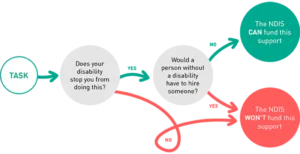
Original checklist or chart explained
The historical chart asks whether disability stops the person doing the task, then whether a person without disability would hire someone for it. It routes a yes to the first and no to the second towards funding, and other answers away from funding. This is a simplified historical diagram, not the complete current eligibility test. Ordinary property repairs and maintenance remain excluded; check the current support rules and actual plan before purchasing assistance.
Gardening, cleaning and home maintenance in your NDIS plan
[Clickability update, September 2026: Core funding is not universally transferable. Check stated supports, restricted categories and funding availability in your actual plan before reallocating spending. Use the current budget guidance.]
What if they are not registered with the NDIS?
Things to take into account when hiring a gardener, cleaner or handyman
- Set up a service agreement – As with any service provider you engage, it’s always a good idea to establish a service agreement with a gardener, cleaner or handyman. This is a simple written agreement that states how and when your services will be delivered, and will help protect you from any misunderstandings about the services being provided.
- Agree upon a price – The NDIS uses an hourly-rate system for these services, so you and your service provider will need to agree on how much this is prior to starting the job. Also make sure they invoice you correctly. Keep in mind the NDIS won’t pay for any amounts outside of the hourly rate, so any incidental costs will need to be built into this. If they’re not, be aware that you may have to cover them out of your own pocket.
Here are our top tips for NDIS home maintenance:
-
The NDIS can help pay for support with gardening services, house cleaning and home maintenance, but only if:
- your disability is preventing you from doing it yourself; and
- most people wouldn’t require a specialist to complete it
-
Gardeners and cleaners must charge at an hourly rate, so be sure to agree on this first.
-
If there are any additional costs, they can’t add these to their NDIS invoice. They’ll either need to build them into their hourly rate or you’ll have to cover them yourself.
[Clickability update, September 2026: Do not bundle ordinary products or excluded costs into an hourly rate to make them claimable. Any separately claimable charge must meet the current item and pricing rules, agreement and plan; ordinary expenses remain separate. Check effective pricing arrangements.]
-
Set up a service agreement with them to ensure you’re not caught out!
-
To ensure their invoices comply to the NDIS rules and regulations, point out our handy guide to your gardener, cleaner or handyman.
Compare the complete household job and quote
Compare the whole visit, not just an hourly rate
Consider an illustrative quote of two hours at $55, compared with three hours at $50. The totals are $110 and $150 before any permitted extras. The lower hourly rate is not the lower visit cost. Ask what each visit includes and how often it is needed; this example does not establish funding or imply either provider is better.
If you help arrange a service, ask the participant which areas matter most, when workers can enter and how they want unfinished tasks handled. Avoid promising that every room or the entire garden will be completed within a short booking.
Keep a change in tasks separate from a funding decision
Stop and discuss an unexpected repair, specialist trade job or additional materials before doing the work. Explain the proposed price and who is responsible for paying it. Do not absorb an excluded purchase into a higher support rate to make it appear claimable. Use the actual support item and applicable current limit for funded assistance. Read the official guidance
Record agreed frequency, access arrangements and how either party can change the booking. Revisit the schedule if tasks or available funding change rather than continuing on the strength of an old quote.
Questions readers ask
Does the diagram approve a home repair if I cannot do it myself?
No. The historical diagram is simplified; ordinary home repairs and maintenance are excluded under current support rules. Official guidance
Can ordinary cleaning products be hidden in the hourly support charge?
No. An excluded expense does not become eligible by being bundled or relabelled. Official guidance
Can I assume all Core funding can pay for household assistance?
No. Check the flexible or stated wording, available funding and support rules in your actual plan; a budget label alone is not permission. Official guidance
Find cleaning support for the tasks you need help with
Tell Clickability the household assistance and location you need. Compare cleaner profiles and reviews, then confirm tasks, rates and any privately paid costs.
Find cleaning providers for my needs · Browse cleaning providers