NDIS provider decisions: limits, frontline input and participant choice
What should providers be doing right now? A candid panel's answers
By Clickability · Originally published 24 August 2026
Original article and dated context
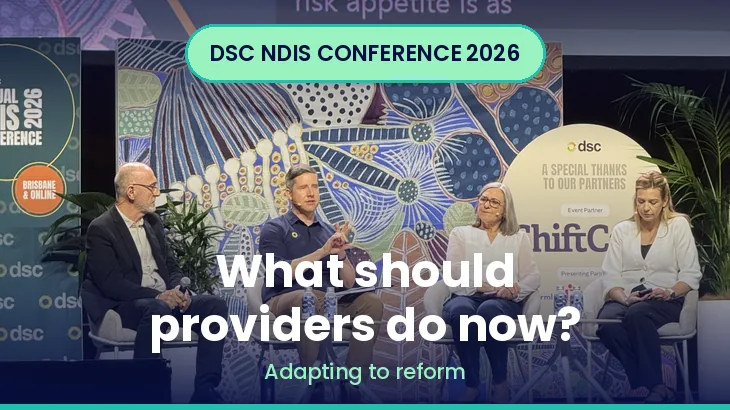
If the last few years of NDIS change were waves, this round is a tsunami, and no one, no participant, no intermediary and no provider, will be left untouched. That was the framing Roland Naufal opened with, before putting a blunt question to three people who know provider life inside out: DSC's Ann Drieberg (who also runs Untapped Customer), Natarsha Warren (DSC, and GM of Day Services at Bailey House) and Rob Woolley (DSC). What are providers doing now that simply won't cut it?
The end of "yes to everything"
Rob Woolley led with a deliberately provocative answer: the habit of saying yes to everything. Providers have long characterised themselves as the ones who step in where no one else will, and a decade ago the decision was simple, was there money in the budget and did you have workers? Now, he said, there are far more factors to plug into every decision: impairment notices and categories, section 33 funding periods and how they're split, state support, section 46, and on it goes. That does not mean the glib advice to "stop doing free stuff", providers will always invest beyond the plan, but it does mean being far more critical, nuanced and deliberate about what you say yes to. It is, he stressed, an enormous cultural change, and it requires deliberate, transparent conversations with participants: we could do this ten years ago, we're in a different world now, but here's a more flexible version we can do.
Ann Drieberg named a different habit: assumptions. The sector has too often assumed it knows what people want and built services from there. That no longer holds. Providers need to genuinely ask, engage and understand what people want, then deliver it in new ways within new budgets, and crucially, not let all their energy be consumed by compliance and pricing at the expense of the humanness of support.
Natarsha Warren pointed to reactivity. Providers rarely get time to test models and scenarios or really understand what things cost, so they react fast without a plan. Flipping that, finding time amid the chaos to plan, is essential, as is confronting unsustainable unfunded work. Her key point: the gold and the risk both sit with your frontline teams, and they need a real voice in change rather than feeling, as one leader told her, like "a towel in a dryer."
Turning big fires into small ones
Asked what separates organisations that avoid constant firefighting, Rob offered three things. Know your limits by plugging the technical factors into decisions, so you know clearly what you can and can't take on, and what your risk appetite is. Over-communicate that with participants, including honest risk-sharing. And find the positives: funding periods may crimp choice and control and add admin, but they also tell you the envelope you're working within, so the successful organisations reframe the hard things to make them work.
Start with the person, not the payer
Ann made the panel's most quotable case. All work, she argued, should start with the people you serve, yet the sector has tended to give power to whoever it thinks is paying, when ultimately the people paying are the people you support. Start with the person and the problem you're solving together, and you reach a better service, a better outcome and a more viable one, with funding and viability as the second lens, not the first. Natarsha described doing exactly this at an organisational scale: asking participants what they need, taking that to staff, then management, then executive, building ownership and engagement all the way up.
Empowering the frontline for real
On frontline leadership, Natarsha named three focuses: quality (modelling and coaching what great support actually looks like, by being on the ground observing, not a removed leader), building workforce capability, and looking after their own boundaries, because a leader who can't switch off breeds a team that can't either. And genuine empowerment means authority to act, not pushing every decision through three layers of approval.
What would you do on Monday?
The closing question drew the most practical answers. Rob would have a conscious risk-appetite conversation across the organisation, nailing down why you say yes, why you say no, and how you communicate no, and would identify the "unicorn" workers who can do both the technical work (the Act, the guidelines, the plan) and communicate it with empathy, clear their decks, invest in them, and free them up to be out with participants. Ann would listen, setting up a genuine engagement approach to hear from both participants and staff, but framed around the future and hope ("what would it look like for you, and how can we support you to do that?") rather than only worry, and at an organisational level: help us design a service that can be here for you. She added a discipline: check yourself whenever you've made an assumption. Natarsha would go straight to the frontline to ask what's working, what isn't and what needs to change, and would bring in a short list of practice models such as active support and practice leadership, because quality is survival: you won't get through the changes if you're not delivering high-quality support.
What this means for providers
The through-line is a shift from reactive, say-yes-to-everything generosity to deliberate, participant-led, well-planned decisions, with a hard commitment to frontline quality. Practically: set an explicit risk appetite and communicate it, invest in your best combined technical-and-empathy staff, plan scenarios rather than firefight, and start with the participant before the funding envelope.
What this means for frontline workers and leaders
The panel put the frontline at the centre. Expect (and ask for) a real voice in decisions, clearer boundaries modelled from the top, and genuine authority to act. The message to leaders: get on the ground, observe and coach, and protect your own capacity so your team can protect theirs.
What this means for participants
There was an unusually honest message here: providers are being urged to be more transparent about what they can and can't do, and to design services with you rather than for you. If a provider is having franker conversations about limits, that is the sector adjusting, not pulling away, and they want your input on how they stay viable enough to keep supporting you.
What this means for support coordinators and intermediaries
As providers get more deliberate about what they'll take on, clear communication about plans, funding periods and limits becomes vital. The complex-needs question the panel closed on, how to keep supporting people whose plans are undercooked, is one intermediaries will help navigate, with the panel urging creativity and combining resources rather than closing doors.
Q&A
How do we find time to support clients with complex needs when we're not adequately funded for it? Rob took some solace that the reforms are meant, in theory, to refocus on participants with complex needs, and that there's a groundswell holding the NDIA to account for undercooked plans, though not overnight. The panel urged creativity, combining resources with other providers and thinking outside the box, because providers cannot simply stop supporting people with complex needs because the funding is thin.
[Clickability update, October 2026: This is the panel’s advocacy, not a statement that every provider must deliver unlimited unfunded work. Changes still need lawful, safe arrangements and appropriate participant transition. Do not pool or redirect funds without the relevant authority and eligible support.]
How do we deal with the misalignment between financial viability and participant expectations? The answer was one word, repeated: together. If participants can't engage your service because you're not viable, everyone loses, so the impact has to be solved jointly.
Meet the speakers
Ann Drieberg, DSC and Untapped Customer Ann works with DSC and runs Untapped Customer, which connects organisations with people with disability to help them serve them better; her focus is asking the questions that surface what people actually want.
Natarsha Warren, DSC; GM of Day Services, Bailey House Natarsha builds frontline capability with DSC and is General Manager of Day Services at Bailey House in Melbourne.
Rob Woolley, DSC Rob has seen provider life from almost every angle, support work, advocacy, consulting and running his own provider, with a strong commercial focus grounded in a genuine participant lens.
Roland Naufal, Director, DSC (host) Roland is a Director of DSC with decades in the sector.
Read the full picture: from the reforms reshaping the NDIS to who's expected to stay or go and the crackdown on unscrupulous providers, we've pulled every hot topic and its likely outcome into one quick overview, then gone deeper on each with its own explainer written for both providers and participants, Q&A included. Get the lot in the DSC NDIS Conference 2026 wrap-up.
A note on this series: this is Clickability's plain-English summary of a session at the DSC Annual NDIS Conference 2026, held on 14 August 2026. It reflects our interpretation and is not the official position of DSC, the speakers or the NDIA, and it is not business or NDIS advice.
Clickability editorial update: October 2026
How providers can explain a support decision without closing the conversation
Describe what the participant wants, the support your service can deliver and the specific constraint. Check the actual plan and eligibility before promising an option. Explain alternatives and how continuity will be protected if your service must change.
Keep a record of the decision, the person’s preferences and who will follow up. The Code of Conduct remains relevant when business pressures make the discussion difficult. A provider’s internal risk appetite does not determine the participant’s rights.
What frontline teams need to make sound decisions
Ask which decisions you can make, when to escalate and where current service information is kept. Bring observations from actual support into planning conversations without sharing unnecessary personal information. If a change appears unsafe or conflicts with agreed support, raise it through the designated process and record the concern.
Questions readers ask
Can a provider’s risk policy override the participant’s rights?
No. Internal business choices must remain consistent with applicable conduct and other obligations. Official guidance
Does a funding period authorise every proposed purchase within it?
No. Support eligibility and the actual plan still matter. Official guidance
Find support with clear communication and agreed arrangements
Tell Clickability what support you need and what matters in how it is delivered. Compare provider profiles and reviews, then discuss limits, changes and backup arrangements before agreeing.