NDIS public debate: stories, evidence and the fraud narrative
NDIS on Trial: who is telling the story, and why it matters
By Clickability · Originally published 24 August 2026
Original article and dated context
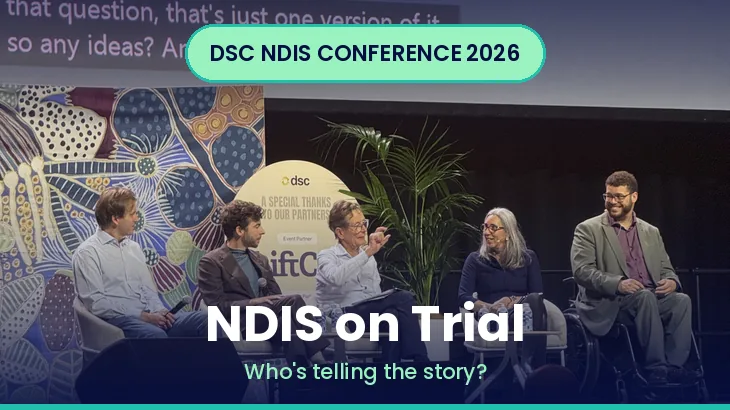
Veteran journalist Paul Barry, long of Media Watch, hosted one of the most charged sessions of the conference: a panel on how the NDIS is being talked about in public, and what that discourse is doing to the scheme. Joining him were Greens Senator Jordon Steele-John, University of Sydney health and social policy professor Jennifer Smith-Merry, DSC's Chris Coombes, and Hireup chief executive Peter Willis. The mood was frustrated, occasionally funny, and unapologetically pointed.
"Not broken, but the way we talk about it is"
Steele-John set the frame: the NDIS is not broken, but the way we talk about it is. At its centre, he argued, is a simple proposition, that disabled people and their families should be supported to live a good life, and yet the public conversation of the past five or six years has been dominated by fraud, rorts and runaway costs. He claimed this narrative was deliberate, pointing to government-commissioned polling (he named the firm Redbridge) that, in his telling, found the public would only accept large cuts if the case was built around fraud and overspending. He cited fresh analysis from The Australia Institute that, he said, put the cost of the proposed cuts at 56,000 jobs and 94 million hours of care work pushed back onto families and carers already near burnout.
[Clickability update, October 2026: The percentages below are attributed to the panel. Fraud, payment error and broader integrity leakage are not interchangeable measures. Do not reuse them as a verified current fraud rate.]
Following the fraud figures
Chris Coombes traced how the fraud story took hold. He recalled an oft-quoted claim that 15 to 20% of the scheme was lost to fraud, and described lodging a freedom-of-information request for the modelling behind it, only to receive heavily redacted pages, with a single line suggesting fraud across all Commonwealth programs was "almost certainly over a billion dollars", not the NDIS alone. He pointed to an Australian National Audit Office figure of 6 to 10% "integrity leakage", noting that this bundles in honest mistakes and possibly money already repaid, and that only 15% of more than 1,000 people surveyed found the new section 10 "in and out" supports lists clear. His kicker: Treasury's own anti-fraud measures in the bill were valued at around $900 million, roughly 1 to 2% of the scheme, a small answer to what is billed as a massive problem.
The discourse has shifted, measurably
Jennifer Smith-Merry brought the research. Work she led with an honours student tracked a significant shift in how the NDIS is covered: from egalitarian hope a decade ago, when Australians were willing to pay more tax to build it, to a debate that increasingly demonises people with disability and the workforce that supports them, sorting people into "deserving" and "undeserving". Referencing Minister Mark Butler's own "social licence" language and a 2023 comment by commentator Peta Credlin, she warned the real cap on the scheme could become public willingness to keep funding it, and that government risks undermining its own scheme through the public narrative.
The human and workforce toll
Peter Willis, whose Hireup platform connects around 14,000 workers with participants, described the effect on morale: it is tiring, he said, and telling people you work for an NDIS provider now draws sideways glances at the barbecue. His deeper worry is workforce, that a relentless negative narrative undermines the sector's ability to attract and retain great support workers and to offer real careers, feeding turnover and short-term behaviour. Hireup still sees 400 to 500 workers join monthly, but he has noticed more transience.
But is cost a problem?
Barry pushed back, and it was the panel's most useful tension. The scheme was first estimated at around $13 billion for 400,000 participants; it now supports around 750,000 people at roughly $52 billion. Is cost not a real issue? The panel's answers were layered. The original costings, they argued, were best guesses based on broken state systems that missed many people (half of eligible Queenslanders, by one claim), and were always expected to rise. Steele-John insisted the scheme is a net economic good, citing Per Capita research that every dollar returns about $2.25, and argued the debate ignores jobs created and people enabled to work. He was candid that inefficiency and waste exist (the agency, he said, spends heavily fighting participants over small items then settling before tribunal) and that fraud is real and "disgusting", particularly provider fraud, and that driving out bad actors would help. Smith-Merry offered an inconvenient thought: the true cost of supporting everyone to a good life might be higher than $50 billion, and the fixation on NDIS cost has starved foundational supports for people with psychosocial disability outside the scheme. She and Steele-John both pointed to the care economy as a major driver of recent job growth and one relatively resistant to automation.
Changing the story
On solutions, the panel converged. Reframe the NDIS as the public insurance scheme it is, not welfare, but back it with data the government has been unwilling to publish. Tell more positive, non-patronising stories about the freedoms and choices the scheme enables. Build a vision for reform rather than only rebutting falsehoods. Smith-Merry made a direct ask of providers: document and evaluate what you do, noting her team could not find a single published evaluation of NDIS housing supports to point government to. Coombes urged the room to use their own platforms and communities to share human stories, and recommended Professor Shane Clifton's essay "The Deep Well of Care" for elevating support workers; his own account of getting up at 5am to deliver skilled personal care ("if you think that's unskilled labour, meet me in the car park") was a highlight. Steele-John's blunt call to action: politicians bank on people believing they are powerless, so be annoying, phone an MP today and tell them what the changes mean for real lives. And, several panellists agreed, employ disabled people in executive and board roles, because disabled people are doing the sharpest advocacy on reform.
[Clickability update, October 2026: The 2026 Act has passed. These are the panel’s earlier opinions and forecasts. For actual implementation, consult current guidance, including the funding changes and safeguards.]
Looking two years ahead
Asked where things land, the panel was sober but not without hope. Coombes hoped that if the bill passes and genuinely addresses integrity, the fraud narrative can finally be put in the past and the conversation reset toward human rights, dignity and quality, with benefits measured properly. Steele-John was starkest: if the bill passes, he said, nearly $40 billion would come out of people's supports and a large share of community participation funding would be stripped, despite witness after witness to the inquiry warning it should not pass in its current form. Smith-Merry warned the reforms are complex to implement and might not save what is claimed while leaving underlying inequities unaddressed, but ended on optimism: people with disability are back in the media spotlight and talking about the scheme's value, which she sees as the egalitarian instinct that built it reasserting itself.
What this means for providers
The panel's practical message: you are part of the story whether you like it or not. Document your outcomes and get them evaluated, share genuine (not patronising) participant stories through your own channels, and build relationships with journalists now. And take the reform debate seriously rather than only defending the status quo.
What this means for participants and families
Your voice and your story carry weight in this debate, and the panel argued they are among the most powerful counters to a negative narrative. Steele-John's encouragement to contact MPs directly applies most of all to the people the scheme supports.
What this means for support coordinators, advocates and intermediaries
Evidence plus advocacy is the combination the panel called for. Helping participants tell their stories, and pointing to what actually works, is advocacy that shapes both public opinion and policy.
Meet the speakers
Paul Barry (host) Veteran investigative journalist and long-time host of the ABC's Media Watch, with a career focused on scrutinising the media.
Senator Jordon Steele-John, Australian Greens (WA) Greens Senator for Western Australia and a long-standing disability rights advocate.
Prof. Jennifer Smith-Merry, University of Sydney Professor of Health and Social Policy at the University of Sydney, with a research focus on the implementation of the NDIS.
Chris Coombes, DSC Part of the Team DSC team, focused on NDIS policy and analysis.
Peter Willis, CEO, Hireup Chief Executive of Hireup, an online platform connecting people with disability to support workers.
Read the full 2027 NDIS changes summary from the reforms reshaping the NDIS to who's expected to stay or go and the crackdown on unscrupulous providers, we've pulled every hot topic and its likely outcome into one quick overview, then gone deeper on each with its own explainer written for both providers and participants, Q&A included. Get the lot in the DSC NDIS Conference 2026 wrap-up.
A note on this series: this is Clickability's plain-English summary of a session at the DSC Annual NDIS Conference 2026, held on 14 August 2026. The panellists expressed strong personal and political views; those views are theirs, reported here for interest, and are not the position of Clickability, DSC or the NDIA. Figures cited by panellists are attributed to their sources and have not been independently verified. This is not political or NDIS advice.
Clickability editorial update: October 2026
Keep control of how your experience is shared
Decide what you want the audience to understand and what you prefer to keep private. You can explain a service barrier or a positive outcome without disclosing every detail of your disability, finances or family. Ask where your story will appear, whether your name or photo will be used and whether you can review the proposed wording.
Agree only to the use you are comfortable with. Being invited to tell a story does not require endorsing every policy position of the organisation publishing it. The Commission’s rights and responsibilities standards support respect for privacy, dignity and choice.
Show outcomes without turning people into promotional evidence
Explain how you obtained consent and what a published result actually measures. A person’s account can illustrate an experience; it cannot establish a result for every participant. Avoid presenting one improvement as proof of your whole service model.
When discussing policy, name the source, date and measure. Keep fraud allegations separate from errors and projections separate from observed outcomes. The NDIS Code of Conduct includes privacy and integrity responsibilities that apply when telling stories as well as delivering support.
Questions readers ask
Are the panel’s fraud and savings figures independently verified here?
No. They remain attributed historical claims; the refresh does not convert them into verified statistics.
Does the panel discussion determine an individual plan change?
No. Use actual NDIA communication and current implementation guidance. Official guidance
Find providers you can assess for yourself
Describe your support needs through Clickability. Compare provider information, reviews and ratings, then ask the questions that matter to your choices.