Leading through NDIS reform: practical lessons for providers
Leading through noise: how the sector's leaders are holding steady through reform
By Clickability · Originally published 19 August 2026
Original article and dated context
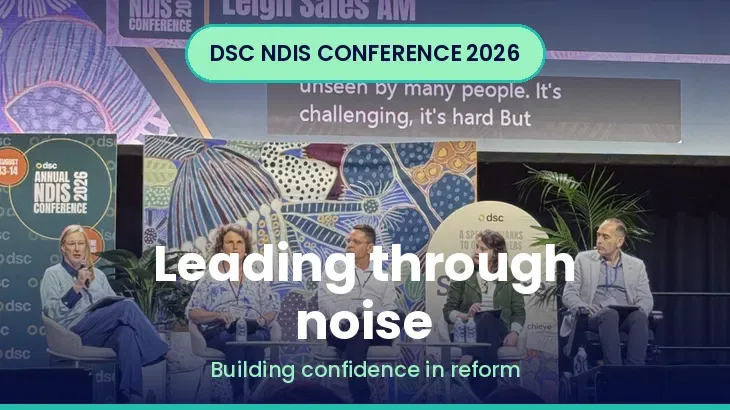
To close a day heavy with reform detail, the conference turned to a different question: not what is changing, but how you lead people through it. Hosted by journalist Leigh Sales, the panel brought together four leaders, Jeramy Hope of the SDA Alliance, Emma Bennison of the Disability Advocacy Network Australia, Maeve Kennedy of Inclusion Australia, and Simon Wardale of Vertaview Group and Multicap, to talk honestly about leading in a period of stress and uncertainty.
The tone was set early. This is a genuinely hard moment, the panel agreed, and pretending otherwise helps no one. The most striking through-line was that good leadership right now starts with acknowledgement, not answers.
Start by listening, and by naming that it's hard
Jeramy Hope put it plainly: leading at the moment is a lot of listening, because there are not a lot of easy answers. His approach is to be present and available, to acknowledge with both participants and providers that this is hard and unfair and full of unknowns, and that it is okay to sit in that. But he paired it with a forward look: work through the anger, turn it into workable solutions, and above all work together rather than advocating alone. His challenge to the room was to be brave enough to partner with people you would not normally work with, to co-write, to go to government together.
Keep the message simple for the frontline
Simon Wardale argued that leadership is about simple messages. His fortnightly note to staff is deliberately narrow: go and deliver outstanding disability services, and ask the people you support whether you are meeting the quality they expect. For frontline teams, he said, quality is the only thing that needs to be on their mind; the rest is for others to carry. He drew confidence from the sector's track record through waves of change, from restrictive-practice reforms to multiple iterations of the NDIS and its Commission: the sector does change well, so lead through it and keep the frontline doing what has always mattered.
Look after each other so you can keep going
Maeve Kennedy reframed leadership as endurance. Inclusion Australia represents people with intellectual disability, a community often hit hardest by service gaps and reform decisions, and more than a third of her own team, over half if you count family, have intellectual disability. So the work is personal. Her message was "you're not alone," and her focus is on keeping going and looking after one another well enough to sustain that. As she put it, the sector has enough external fires to fight without starting its own; if leaders can collaborate and care for each other, they can outlast a hard patch that will stay hard for a while yet.
Lead with honesty, vulnerability and grace
Emma Bennison, speaking as a disabled leader, was direct: many people with disability are frightened right now, and leaders need to acknowledge that fear while being honest that they feel it too, without tipping into a fearful mess. The word she kept returning to was grace, extending it even to people in government and ministerial offices who are trying to do their best. Practically, she leans on role-modelling: taking real rest, calling out inaccessible consultation processes, and genuinely listening, because one disabled person's experience is not another's. And she urged sharing power with allies, including non-disabled people who feel they have no right to be afraid but are, because sharing power is what gets everyone through.
What this means for providers and leaders
The practical takeaways are unusually human ones. Narrow the frontline's focus to quality and shield them from the noise above. Resist leading alone: partnerships, joint submissions and shared advocacy carry more weight and more resilience than solo effort. And model the behaviours you want, rest, honesty, calling out what is broken, because that does more than any reassuring email.
[Clickability update, October 2026: Acknowledging difficulty can be useful, but it is not enough to establish good leadership. Look for accessible communication, action on concerns and respect for participant choices alongside the words.]
What this means for participants
If the people leading and supporting you seem to be naming how hard this is rather than papering over it, that is a sign of good leadership, not weakness. The panel's shared commitment was to keep participant voice and lived experience at the centre of decisions, and to be honest about uncertainty rather than offer false comfort.
What this means for support coordinators and frontline workers
The steadying advice here is to keep your attention on the quality of what you deliver day to day, and to keep asking the people you support whether it is landing. In a period where much feels out of your hands, that is the part that is firmly within them.
The panel did not pretend to have solved anything. Its confidence came from somewhere simpler: the sector has led through hard change before, it is full of resilient people, and it will come out the other side still delivering. Or, in the mantra one panellist borrowed from a friend in another tough sector, we do what we can.
Simon Wardale, Group Executive Disability, Vertaview Group and Multicap
Leigh Sales AM (host) Journalist and author who hosted the panel.
Read the full picture: see all our conference takeaways in the DSC NDIS Conference 2026 wrap-up
A note on this series: this is Clickability's plain-English summary of a session at the DSC Annual NDIS Conference 2026, based on a partial recording from the day (13 August 2026). It reflects our interpretation and is not the official position of DSC, the speakers, their organisations or the NDIA, and it is not NDIS advice.
Clickability editorial update: October 2026
Make reassurance something your team can act on
Give staff a clear way to distinguish confirmed operational changes from issues still being discussed. Explain what they should do differently, who can answer questions and when the information will be updated. Listening becomes useful when people can see what happened to the concern they raised.
Keep participant feedback alongside staff feedback. If a change affects continuity, communication or a chosen worker, explain the options early and record the person’s preferences. The NDIS Code of Conduct remains relevant during organisational pressure; a calm message cannot substitute for safe delivery.
Keep quality visible and raise what gets in its way
Ask the person whether the support is meeting their priorities and record concerns through the appropriate channel. If workload, unclear instructions or a service change puts safety at risk, escalate it. Focusing on good support does not mean carrying a problem silently.
Ask your supervisor which changes affect your role and what training or clarification is available. The Commission’s working-together guidance offers a practical basis for supervision and communication. A supportive workplace should make questions easier to raise and follow up.
Questions readers ask
Is naming uncertainty proof of good leadership?
No. Assess communication, participant involvement and follow-through as well as the message.
Should workers ignore risk to stay focused on quality?
No. Raising and responding to concerns is part of safe support. Official guidance
Find support that listens and follows through
Use Clickability to describe the services you need. Compare reviewed and rated profiles and ask how providers respond to feedback and maintain continuity.