Powerchair sport: belonging, competition and a place to play
On Disability and Sport
By Tristram Peters · Originally published 15 July 2015
Original article
Tristram Peters is a writer, editor, and disability advocate with a keen passion for sport. He recently represented Australia at the powerchair football world cup and sits on the sport’s executive board for the Asia Pacific Oceania zone. Most importantly, he’s part of the Clicka-family!
I love sport. To be honest, I can’t remember a time that I didn’t. It’s the roar of the crowd, the slow-motion montages, and the release of adrenaline after a rare grand final win. I’m the unforgivable person who watches a full replay of a match after having just attended the very same game, the crumpled ticket still in my pocket. I carry this love of sport wherever I go, like a well-worn jersey. But more than anything, I love to play it.
This might surprise some, as I’m not your typical footy-playing twenty-something. I have a rare genetic condition called Spinal Muscular Atrophy Type II, which leaves me reliant on an electric wheelchair for my everyday mobility. My neck is weak and floppy, and my arms resemble those of a T-rex, all short and angular. Simply, I do not possess the physical attributes that one associates with sport—and I’m okay with that.
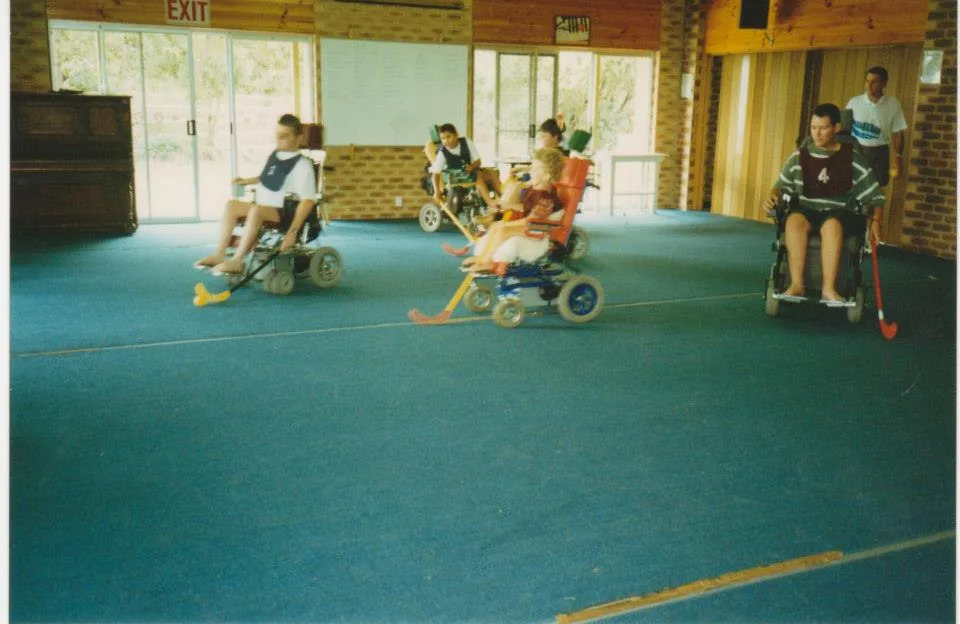
However, when I was four, I attended a camp for people with muscular dystrophy. It was an opportunity to meet people who had similar conditions and to swap stories and advice. But I will remember it for one reason: they held a wheelchair sports demonstration. See that photo there? That’s me playing wheelchair hockey for the first time in my life.
Within a few years, I had joined a local league in South-East Queensland. It was part of a broader network of leagues throughout Australia that featured wheelchair hockey, soccer, and rugby league. Each sport had been adapted to suit the needs of its participants. For instance, the rugby league rules allowed us to pass the ball by calling out the number of a teammate, who would then yell “got it” to accept possession. We attached bull bars to our wheelchairs and got into it. Up the guts, as rugby union’s Honey Badger (Nick Cummins) might say.
Undoubtedly, since that first hockey game, sport has become my life. I’ve participated in national and international competitions, playing competitive sport at every opportunity. I’ve now taken up powerchair football, a new sport that reaches for the Paralympics. The Queensland Powerchair Football Association has recently aligned with the Brisbane Roar, with similar deals with A-League clubs having already been established in New South Wales. It’s simply sport now, minus the disability, as it shuffles into the mainstream.
And this is why I love it. At the risk of sounding overly sentimental, wheelchair sports offers me the opportunity to forget the disability. In every other aspect of my life, it’s different: at work, university, or parties, I have to organise carers to come in and assist me with my personal care, and I often leave early because of fatigue. Everyone is beautifully understanding in each instance, but it’s still a reminder that you can’t always put a positive spin on life with a disability, no matter how hard you try.
However, sport is sport. I play with teammates who know what it’s like. Beyond the benefit of exercising, sport allows us to network and compete. We revel in the small act of saving a goal or scoring a buzzer-beater, the thrill of making a last-ditch tackle or the crowd cheering us on. They might seem like small things, but sport affords me the opportunity to discard my disability, for a time at least.
There’s no better example of this than last week, when I ran a wheelchair sports demo in Brisbane. The demo was for students with disabilities in grades one to five. Most of them had only just received their first wheelchair, but for three hours, in a freezing cold hall, they raced around hitting a soccer ball. For some, it was their first opportunity to actively participate in physical education. It was neither inspiring nor spine-tingling; instead, it was a group of wheelchair-users discovering sport for the very first time, laughing and smiling, with a sprinkling of friendly banter thrown in. And this is why I love it.
Ask a club about the first session that would work for you
Check the venue route, toilets, chair and footguard requirements, trial sessions and who provides any personal assistance. Describe what you want from playing, whether that is recreation or competition. The Australian Powerchair Football Association explains the sport and links its member associations.
Make the access plan without taking over the game
Ask the player what help they want and let coaches speak directly with them. Confirm transport, charging, personal assistance and rest arrangements. Separate ordinary club costs from any eligible disability support: the NDIS exclusions list includes recreational and elite sporting expenses. Check specific support arrangements before spending.
Questions readers ask
Is playing powerchair sport automatically an NDIS expense?
No. Ordinary and elite sporting costs are excluded; disability-related assistance needs its own eligibility check. Official guidance
Arrange assistance for getting involved
Tell Clickability what practical support would help you attend an activity, then compare providers who can discuss the access and timing you need.