The care economy: what alignment means for NDIS providers
The care economy is quietly aligning: what disability providers should do about it
By Clickability · Originally published 24 August 2026
Original article and dated context
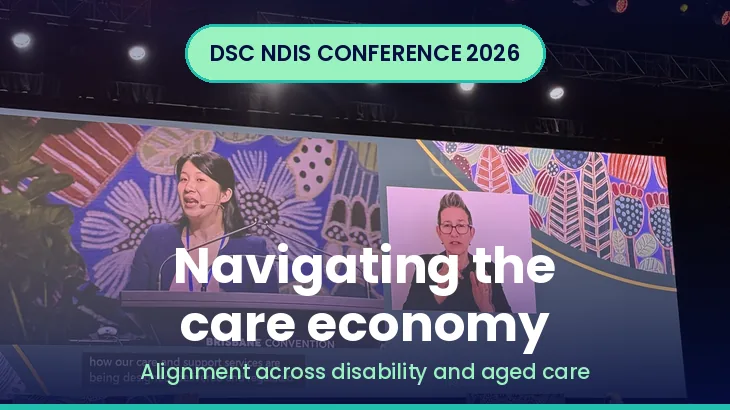
Not every important shift makes headlines. Sam Thorp and Angela Poon of Social Ventures Australia used their session to spotlight one that is happening slowly in the background but will reshape how care is designed, delivered and regulated: the gradual alignment of Australia's separate care sectors, disability, aged care and veterans' care, into a more connected care economy.
The USB-C analogy
Their framing was neat. Remember when every device needed a different charging cable, and you carried a drawer's worth around? Most devices have since moved to USB-C. The devices did not change (a phone is still a phone), but the underlying way you power them became consistent. Australia's care economy is going through the same slow-motion shift. Disability, aged care and veterans' care each still serve different needs, but governments are increasingly standardising the shared "charging ports": workforce standards, quality and safeguarding, and registration. The aim is a system that is more efficient and less frustrating for everyone.
[Clickability update, October 2026: The phrase “ageing out of the NDIS” below is misleading. NDIA transition guidance explains that a person who entered before 65 can remain after 65, subject to applicable transition rules.]
What's driving it
Several forces are pushing this along. A meaningful share of providers already operate across sectors (a straw poll of the Alliance20 providers put it around 40% offering both disability and aged care), yet doing so is hard because the underlying systems and legislation differ. There is also a productivity imperative: an ageing population means more people needing aged care than there are workers entering to provide it, and the NDIS is hunting for efficiencies. People increasingly move between systems too, including participants ageing out of the NDIS, and the presenters cited a man with advanced motor neurone disease who simply could not get sufficient support through an aged care system never designed for it.
[Clickability update, October 2026: The Productivity Commission report makes recommendations. A recommendation for common screening or regulation is not proof that one clearance, audit or registration now covers every care sector.]
The evidence it's already happening
Thorp and Poon pointed to a run of developments. The 2024 Aged Care Act embedded a rights-based approach closer to the NDIS's choice and control, strengthened aged care quality standards toward the NDIS Practice Standards, and recognised the NDIS Worker Screening Check to cut duplication. In 2025, machinery-of-government changes moved most Commonwealth disability functions into the new Department of Health, Disability and Ageing. And the Productivity Commission's report, Delivering Quality Care More Efficiently, recommended a single national worker screening check, cross-sector provider registration and audit, a combined modular set of practice and quality standards, aligned regulation of restrictive practices, and a common suitability test across sectors including early childhood education and care, all under the banner "report once, use often." Add a place-based integrated care and commissioning trial running across six sites (focused on rural, remote and First Nations communities), and an ANAO audit due late this year examining whether government has coordinated market stewardship across the care economy, and the direction of travel is clear, even if the pace is not (government has not yet responded to the Productivity Commission).
What it means for providers
The presenters were honest that the near-term reality is complexity: changes to auditing, worker registration and the systems underpinning your work, on top of everything else the sector is navigating. But on the other side sit real implications. Streamlined compliance (no more repeating worker checks and audits for each market) mostly benefits providers who operate, or want to operate, across systems; those choosing to stay firmly in disability, often a sound strategy, will feel the complexity without much of the benefit. Alignment also lowers the barrier for disability providers to expand into aged care and adjacent services, and vice versa, meaning more opportunity but also more competition. Collaborative commissioning may grow if the trials succeed, though the presenters expect it to stay concentrated in rural, remote and First Nations communities, and it demands a different skill set built on close collaboration with government, health and other providers. And workforce mobility cuts both ways: it becomes easier for staff to move across sectors, which can make care a more attractive career, but widens the pool everyone is competing for.
How to position for it
Their practical advice came in four parts. First, understand the whole journey of the people you support, because people do not experience their lives in sectors, they experience a single journey, so ask participants where they hit service gaps. Second, build cross-sector thinking into your strategy: watch adjacent sectors, evaluate where your services and infrastructure overlap with them, and decide what role you want to play. They pointed to the 2024 merger of Yooralla (disability) and Berry Street (trauma and disadvantage) as exactly this kind of thinking, prompted by a growing number of children entering out-of-home care with disability and mental health needs. Third, strengthen partnership capability, since collaborative commissioning rewards those who can demonstrably work well with government, health, community organisations and schools, built on trust, shared goals, clear roles and good data sharing; they suggested learning from England's integrated care systems and, closer to home, Aboriginal Community Controlled Health Organisations, and noted this matters for Thriving Kids partnerships too. Fourth, support a multi-skilled workforce: disability-specific expertise stays critical, but broader capabilities like trauma-informed care and dementia awareness become more valuable as needs grow more complex.
What this means for participants and families
The promise for participants is a less fragmented experience: fewer duplicated checks and smoother movement between systems, for example as someone ages or has needs that cross disability and health. The presenters' core point is participant-centred: services should be built around your whole journey, not just one sector's slice of it.
What this means for support coordinators and intermediaries
You already see where systems fail to join up for the people you support. As alignment progresses, that cross-system knowledge becomes even more valuable, and helping participants navigate between disability, aged care and health, and flagging the gaps, is squarely your territory.
The takeaway echoed the analogy: done well, alignment keeps every sector's specialist, unique services intact while making the shared foundations far less annoying. But to benefit, providers need to see it coming and set themselves up strategically now.
Meet the speakers
Sam Thorp, Social Ventures Australia Sam works with Social Ventures Australia on strategy and financial sustainability across the care and support sectors.
Angela Poon, Social Ventures Australia Angela works with Social Ventures Australia on care economy policy and provider strategy.
Read the full 2027 NDIS changes summary from the reforms reshaping the NDIS to who's expected to stay or go and the crackdown on unscrupulous providers, we've pulled every hot topic and its likely outcome into one quick overview, then gone deeper on each with its own explainer written for both providers and participants, Q&A included. Get the lot in the DSC NDIS Conference 2026 wrap-up.
A note on this series: this is Clickability's plain-English summary of a session at the DSC Annual NDIS Conference 2026, held on 14 August 2026. It reflects our interpretation and is not the official position of Social Ventures Australia, DSC, the speakers or the NDIA, and it is not strategic or NDIS advice.
Clickability editorial update: October 2026
Map your obligations before expanding into another care sector
Start with the services you actually intend to provide, the people they serve and the funding arrangements. Identify the regulator, worker requirements, complaints pathway and evidence needed for each service. Strategic alignment is useful; assuming one existing approval covers a new sector is not.
Where teams share systems, make responsibilities explicit: who obtains consent, who records an incident and who follows up a missed handover? Use the care economy recommendations to assess future options while continuing to meet current obligations. A partnership should close a service gap, with clear accountability for the person using it.
Keep the person’s whole journey visible during a handover
Ask what is failing between systems: duplicated assessments, unclear payment responsibility or a service that stops before another starts. Record the practical gap and help the person identify the contact responsible for resolving it.
For someone approaching 65, discuss their actual situation rather than assuming a birthday ends NDIS participation. Use current NDIA guidance and confirm the consequence of the particular aged care arrangement before recommending a transition.
Questions readers ask
Does turning 65 automatically end NDIS participation?
No. Someone who entered before 65 can remain after 65, subject to the applicable transition rules. Official guidance
Does a recommendation for one screening system mean it already exists?
No. Check the current requirements of each relevant regulator. Official guidance
Find a provider that understands your support journey
Describe your disability service needs through Clickability. Compare relevant experience, reviews and ratings, then ask how the provider works with other services.